
Jesus and the Muddites: John 9:13–23
By Rev Dr Ed Hird, All Saints Crescent Beach
My late father used to sit in the second pew right where Janice is sitting. As an agnostic for many years, he came to faith in part through a birthday present subscription we gave him to the magazine Biblical Archeology. As an engineer, he loved archeology.
Last week Bishop Peter talked about the the blind muddite washing in the Pool of Siloam. Imagine walking while blind for a quarter of a mile from the temple to the Pool of Siloam. That’s faith in action, isn’t it? He showed his obedience by doing what Jesus said. As Nike put it, just do it. As Mother Mary said, whatever Jesus says, do it.
The pool of Siloam by the way had been lost since AD 70, for almost two millennia when the Romans destroyed. In 2004, the pool of Siloam was accidentally uncovered while repairing a broken sewage pipe. Two ancient steps were discovered which when excavated led to the ancient pool of Siloam. Coins embedded in the plaster of the steps showed that the pool was in use during Jesus’ time. Liberal Bible scholars used to teach that this showed that the Bible is just a fairy tale because they couldn’t find the pool of Siloam. I love that as they continue digging in Israel, archeology keeps confirming the accuracy of the Bible.
Today’s gospel about the blind beggar reminds me that I once was blind but now I see. Shortly after finishing my doctorate ten years ago, I was blinded in my right eye with a microscopic macular hole and didn’t even notice, because my left eye autocorrected. It took laser surgery and three days on my face to restore my eyesight. God used surgery and healing prayer to give me my sight back.
You may also know that I lost my voice for 18 months in 1980. My rare condition is called Spasmodic Dysphonia. My GP told me that I would never preach again. After I had throat surgery on May 25th 1982, my voice came back. I supplement this with Botox treatments every four months. It is not perfect, but I have been preaching again for the past 41 years, trusting for even more healing through future medical breakthroughs and prayer.
Our nephew Boyd Dunleavey, a former YWAM missionary, developed leukaemia twelve years ago in 2011. We went and prayed for healing with him in isolation. When we played a video of Janice singing Because He Lives at the Christian Ashram, he had a catharsis with tears. A US serviceman in Japan gave him a bone marrow transplant. He has since run over ten marathons, giving God the glory for healing him through medicine and prayer.
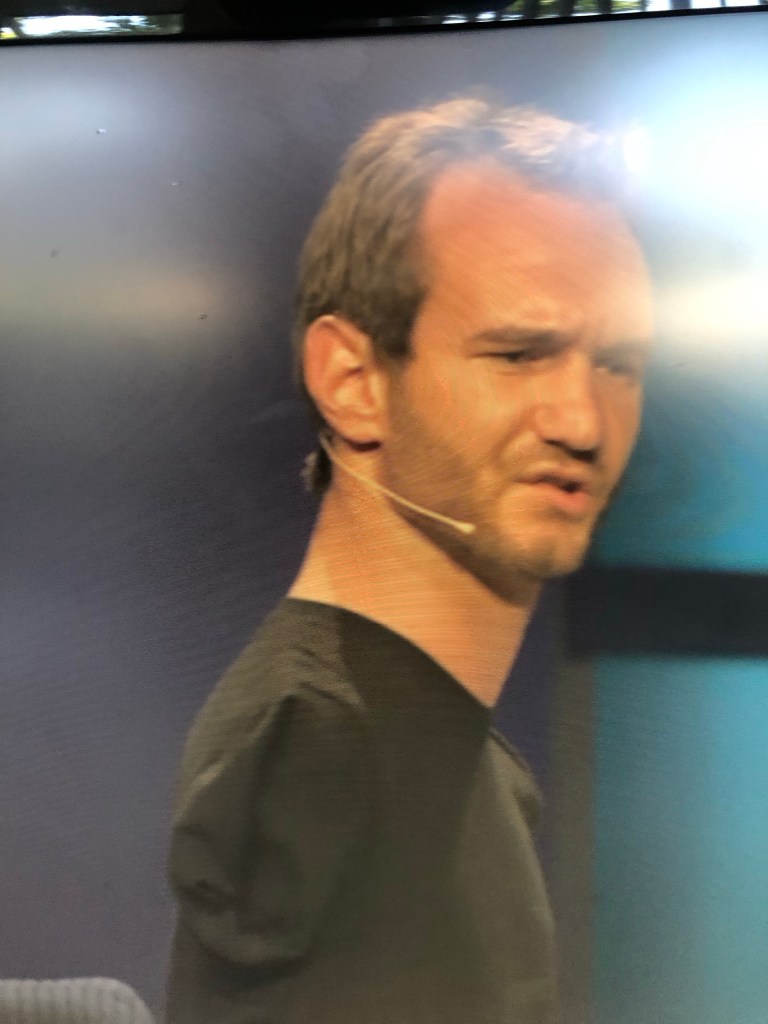
How many of you have heard of Nic Vujicic‘s ministry Life without Limbs? Born without arms or legs in Melbourne Australia, he was led to Christ after reading John 9. He said to Jesus: “If you have a plan for the blind man, you have a plan for me.” Nic has since been used in leading half a million people to Jesus. The largest crowd he has spoken to is 110,000 people in India. He has a vision to preach to all eight billion people on planet earth. Nic tells young people: “You just don’t know what God can do with your broken pieces until you give God your broken pieces. He will give you the strength to get back up.” Nic’s courage shows that each of us as broken vessels, as holy crackpots, can make a difference. You don’t have to wait to be completely whole before God can use you to bring wholeness to others. We are all wounded healers. Can we choose to be grateful while we are waiting for a breakthrough?
Have you noticed that life, family and relationships are often muddy and painfully messy? The healing ministry itself is messy and complicated. Many of us even as Christ followers want simple techniques that guarantee immediate results. Have you noticed that healing through both medicine and prayer often take time? It is easy to get discouraged and lose hope when things take too long and we may face setbacks. Jesus does not want us to give up but rather give over. Surrender of our will is always the way forward. God is willing and able, and we need to daily surrender to his healing will being done, even when it is messy and sometimes painfully slow. Might God be wanting to shift us from ‘woe is me’ to ‘greater is He? Can we give God the glory even as we are trusting for a greater healing that may be taking too long? How passionate are we that the works of God be displayed in us, no matter what it takes? Charles Spurgeon said: “You will never glory in God till first of all God has killed your glorying in yourself.”
The most common reason people go to doctors and emergency wards is pain and suffering. 25% of North Americans experience chronic pain. $635 billion a year is spent in North America in treating pain. Pain raises the ‘why’ question and even causes many to question whether God really loves them.
As Bishop Peter often invites us, can we begin to see God’s goodness even in our suffering? Bishop JC Ryle said in his commentary on John, “losses and crosses are far better for us if they lead us to Christ. There are no lessons so useful as those learned in the school of affliction.”
Part of the messiness of Jesus’ healings is that the Bible records Jesus the Lord of the Sabbath healing seven times on the Sabbath. This doubled the offence, causing some to say that Jesus was a sinner, or worse. Jesus healed on the Sabbath to show as mentioned in Mark 2:27 that the Sabbath was made for humans, not humans for the Sabbath.
Jesus always changed things around in the healing ministry. Healing is not about following a rigid formula. Sometimes Jesus healed with mud, sometimes spit, sometimes laying of hands, sometimes with words, even over long distance.
You can’t put Jesus’ healing ministry into a tight little box. There are no wrong ways to pray when we pray the prayer of faith according to James 5. Jesus never blamed people for not having enough faith, though he did celebrate unusual faith in difficult circumstances.
You can kneel or not kneel, raise your hands or not, cross yourself or not, have laying of hands or not, have anointing oil or not, pray liturgically or spontaneously, pray in tongues or in English. God can use all of these. What matter is the heart attitude of surrender to God’s healing will. As 1 Samuel 16:7 puts it, “humans look at the outside, but God looks at the heart.” I used to pray “if it be thy will” when I prayed for the sick, almost like hedging my bets if nothing happened. God is willing. I now pray according to his healing will, which is sometimes complicated, and messy.
I have found it helpful when praying for healing for others and myself to pray Jacob’s prayer of persistence in Genesis 32:26: “I will not let you go until you bless me.” Sometimes blessings come with a new identity, a new name, and a broken hip. 95% & 5% of us are broken, as Bishop Peter often reminds us. Facing our brokenness and affliction can be both ver scary and very life-giving. Sometimes in hard times, I pray Job’s prayer in Chapter 13:15 “Though you slay me, yet will I bless you.” E. Stanley Jones, who suffered a stroke removing his ability to talk, walk and write, said in his final book the Divine Yes “We can always give thanks, sometimes because of, and sometimes in spite of.
Before Bishop Peter & Jenny went to the Anglican Mission meeting in Florida, they left us some dirt to help with our sermon illustration. Now all we need is some spit. Do we have any volunteers? 😉
Jesus was very earthy and original, perhaps intentionally evoking the creativity in the Garden of Eden where God made bodies and even eyes out of dirt. You can’t get more earthy, more incarnational than mud. Dust we are and to dust we shall return.
How many of you have watched any of the Chosen TV series? You can watch it on YouTube. I love how they portray Jesus healing people with humour, humanity, and compassion. You may remember how the Chosen portrayed Jesus playfully asking the man at the Pool of Bethesda “Do you want to be healed?” Might Jesus be asking you today “Do you want to be healed? Where do you needed to be healed? Might it be physical, emotional, or spiritual? That is why we have prayer teams each Sunday after receiving communion. Many people don’t realize that receiving communion by faith with thanksgiving helps preserve our body and soul. That is why each Sunday at All Saints, we give an altar call to to receive the body and blood that heals, renews and refreshes us.
In Year three, The Chosen portrays Jesus healing a blind woman named Shula. Jesus asks her “Are you afraid to ask for healing?” “Yes”, she answers. Then Jesus asks “Do you have faith that I can heal you?” “Of course”, she says. “Then why haven’t you asked?”, Jesus inquires. She responds, “You have so much to do, Rabbi, so many people who need you more. I’m used to this.” Jesus then says, “You see better than most in this region…” After he lays hands on her eyes, she says with tears, “It’s been so long. I’m afraid to look.” Then she opened her eyes and said, “Yes, it worked. I can’t remember it being so bright. Thank you.”
I want to ask you: Is Jesus still healing today? Yes indeed. Is Jesus the same yesterday, today and tomorrow? Yes. Is Jesus willing and able to heal the sick? Yes. Do we still need to take funerals? Yes. Sometimes death is the ultimate healing, the ultimate homecoming as we enter God’s promised land.
36 million people worldwide are blind and a further 217 million had moderate to severe visual impairment.
There was a tendency in Jesus’ days to falsely blame blind people because the greatest cause of blindness in New Testament times was incurable gonnohrea, often caught by the baby in the birth canal.
Even in 2023, people love to blame others when tragedy or sickness strikes. All of us can easily slip into being Job’s comforters. Why do we do that? It makes us feel safer. If a person has cancer, it is too easy to secretly blame them for not eating right or exercising enough like we do.
Jesus is saying no here to blaming the sick, to the doctrine of karma, and our being cursed for sins of our supposed past lives. What if we stop blaming people and instead focusing on healing and helping people?
There are five separate New Testament accounts of Jesus healing blind people, more than any other kind of sickness that Jesus healed.
Right in Jesus’ Isaiah 61 sermon in Luke 4 is the commissioning to restore sight to the blind. Have you ever thought of Jesus as a heavenly ophthalmologist?
As John Chapter 9 clearly teaches, blindness is more than just physical. It can also be spiritual, emotional, psychological, societal, or political. It is possible to have 20/20 vision and see nothing. Most blindness in Canada is spiritual and emotional. As Hank William sang, “I saw the Light. I saw the Light, No more in darkness, no more in night.”How many of you love John Newton’s song Amazing Grace? “Amazing Grace How sweet the sound that saved a wretch like me. I once was lost but now am found. was blind but now I see.”
There are none so blind as those who refuse to see. We have to admit our blindness in order to see. Jesus paradoxically said that he came into the world so that the blind will see and those who see will become blind. This is obviously metaphorical here as Jesus did not spend time praying for people to lose their physical eyesight. Would anyone here like to come up to the altar to receive prayer in order to physically lose your eyesight?
In a completely darkened room, even those with 20/20 vision are as blind as a bat. That is why Jesus described himself as the Light of the world. No light, no sight. Before my conversion at age 17, I was a blind man in a completely darkened room.
Have you noticed that there are no parables in the Gospel of John? The closest to a parable is the historical story of John 9, which is described as an acted-out parable. John 9 with 41 verses is the longest version of any of Jesus’ many healings. In John 9, the blind man received a double healing of two kinds of blindness, both physically and spiritually. He was just given the ability to see, but also to see Jesus. How many of you remember when you were spiritually blind? What was it like to see the Lord Jesus for the first time?
Dr E Stanley Jones taught that often the best healing is oblique or indirect healing, starting first with our emotions, our anxiety, guilt, and bitterness, and then secondarily result in a physical improvement.
Have you ever been oblivious to how sick or broken you were?
Many us us have logs in our eyes that blind us from being a blessing to others. Who in this church today has no blind spots? It is all too easy to be blind or not self-aware of our own chronic anxiety, and how that affects others, especially those we love. Some of our blindness is false beliefs about our families and how life should work. As they say in AA, denial is not just a River in Egypt. Only the teachable can have their emotional and spiritual blindness removed. Arrogant know-it -all’s are the loneliest blind people on planet earth. Have you ever lied to yourself because facing the truth seemed too painful and overwhelming?
Pastor Steve Cuss from Perth Australia says that there are four ways our relationships get into trouble through areas that we are emotionally blind: 1) Unspoken expectations. 2) Unspoken values. 3) The meaning we make out of what we don’t know. 4) Assumption of motive in the other.
Emotional blindness can kill us. Inuit people in Northern Canada capture wolves by creating popsicles out of a knife covered with frozen animal blood. The wolf will lick the blood popsicle until it cuts its own tongue and doesn’t notice that it is devouring its own blood and killing itself. Our addictions and false beliefs cause us to devour ourselves.
Nice people are sometimes blind to how hard they are on themselves. Many of us have a harsh Romans 8:1 inner critic, that condemns rather than gently convicts. Sometimes that inner critics sounds remarkable like one of our parents that we oils never please, or a former high school acquaintance who loved to put us down as stupid, ugly or weak. Indirect healing often starts when we choose to be as kind and forgiving to ourselves as Jesus is to us. What if you stopped cursing yourself? What if you no longer let your past mistakes and struggles blind you to the amazing future that God is opening up to you?
You may have noticed how the former blind man was blind about who healed him, and his parents were intentionally blind about Jesus in case they would be excommunicated.
Have you observed that meeting Jesus may bring family celebration or sometimes family rejection? The blind man’s parents virtually disowned him out of fear of social consequences. It’s almost like they had an attorney with them, whispering not to say anything. Anything you say may be used against you. How did your family respond when you received Jesus as Lord?
Jesus tells Nicodemus in John 3:3 that unless we are born again, then we can’t even see the Kingdom. We are Kingdom-blind. How many of you can see the Kingdom? Would you like to? Let’s pray.
“They brought to the Pharisees the man who had been blind. Now the day on which Jesus had made the mud and opened the man’s eyes was a Sabbath. Therefore the Pharisees also asked him how he had received his sight. “He put mud on my eyes,” the man replied, “and I washed, and now I see.” Some of the Pharisees said, “This man is not from God, for he does not keep the Sabbath.” But others asked, “How can a sinner perform such signs?” So they were divided. Then they turned again to the blind man, “What have you to say about him? It was your eyes he opened.” The man replied, “He is a prophet.” They still did not believe that he had been blind and had received his sight until they sent for the man’s parents. “Is this your son?” they asked. “Is this the one you say was born blind? How is it that now he can see?” “We know he is our son,” the parents answered, “and we know he was born blind. But how he can see now, or who opened his eyes, we don’t know. Ask him. He is of age; he will speak for himself.” His parents said this because they were afraid of the Jewish leaders, who already had decided that anyone who acknowledged that Jesus was the Messiah would be put out of the synagogue. That was why his parents said, “He is of age; ask him.””
John 9:13-23 NIV

 Edhird's Blog