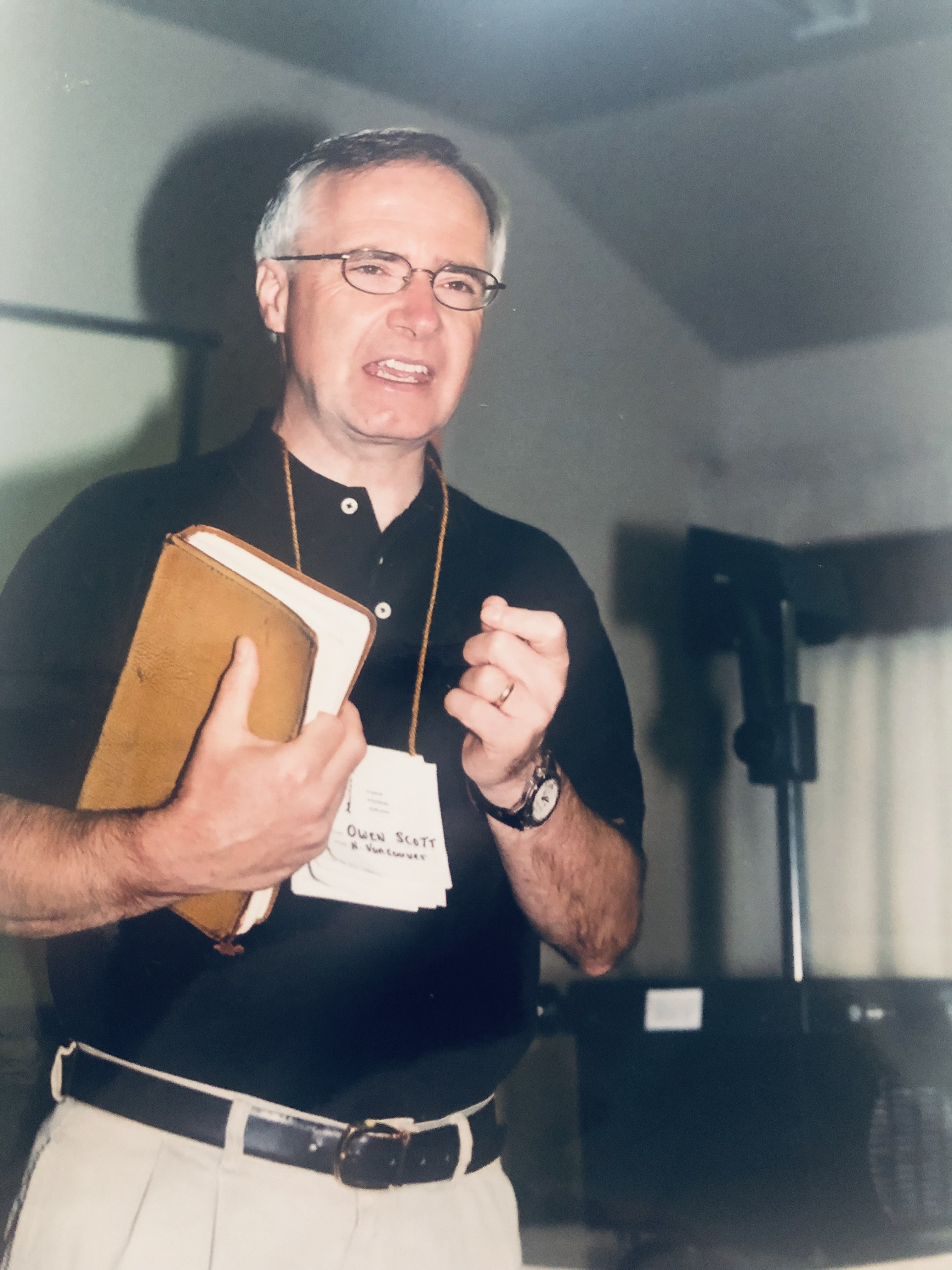
We wanted to let you know that brother Owen Scott, who has been ill for a while, been promoted to glory. We are grateful for the gift of eternal life in Jesus Christ. Brother Owen, who had led Valley Church in North Vancouver, was our evangelist/key note speaker twice for the BC Christian Ashram. Here is a great video of Owen preaching on a Generous Heart
Dear Ed
Greetings from Uganda. So sad that Owen has gone to be with the Lord. On Earth we miss him but heaven celebrated him. Blessed are those who die in the Lord!!!!!!
Keep praying for Connie and I that one day God will bring us to attend the BC Christian Ashram/
May God bless you all.
Medad Birungi
Note from Ed Hird+: Please pray for a miracle that Medad & Connie’s visa to Canada will arrive in time, as the Canadian bureaucracy with its 245,000 Federal workers can now take as long as eight months to approve a visa.
Brother Owen had a deep devotional life, and loved taking part in our silent morning devotion, He was an engaging speaker, with winsome stories, and a gentle pastoral touch. Brother Owen was one of my favorite preachers from whom I learned much. We thank God that brother Owen has now heard from the Lord Jesus ‘well done, good and faithful servant.’ Sadly, he suffered from dementia in his last few years of life, but still remembered his good friends. Because Owen and his wife Val were never able to have any children, church as family and the Christian Ashram as family (Kingdom of God in miniature/koinonia) were wonderful gifts to him. Rev Ed Hird, Director, BC Christian Ashram https://bcchristianashram.com
How does Bishop Peter bless us at the end of each All Saints service? With the Trinity, in the name of the Father and the Son and the Holy Spirit. Happy Trinity Sunday!
Often clergy bless people using the sign of the cross. It is a fascinating blend of the Holy Trinity and Cross. Have you ever crossed yourself? You don’t have to, but it can be a meaningful gesture. Eastern Orthodox people cross themselves in the other direction, right to left. Who is being dyslexic, East or West? 😉 I am sure that God doesn’t mind each way.
How many of you were you raised in a tradition that celebrated Trinity Sunday? The word Trinity is not in the Bible, but the concept is everywhere, three in one and one in three.
Now how many of you enjoy going away on trips? How many enjoy returning home in one piece? That can be painful. I will never forget being at the Honolulu airport with my dear wife waiting to return home to our homeland of Canada. My wife encouraged me to dress warmly in preparation for Canadian cold. I got warmer and warmer as we waited in the hot sun. Suddenly, after having unwisely eating half-price food at a Scottish Hawaiian festival, I fainted and threw up on the feet of the airport attendant. Before I knew it, I was suddenly being sent by a very expensive ambulance to the Honolulu hospital. There were no waiting lists there, but also no health insurance, thanks to a temporary computer glitch. How many of you want to find out that you don’t have health insurance while visiting the USA? I decided to get healthy quick, after being filled up with intravenous fluids. Thousands of dollars later, I was so glad to return home safely on a red-eye flight that night. It reminded me of Dorothy in Wizard of Oz saying ‘There’s no place like home.’ I believe that Canada has one of the best health care systems in the world as long as you are willing to wait for a very long time, which is rather complicated.
For years, the two things I didn’t want to do was clean toilets and door knock. Steve Monks, our St. Simon’s missionary for ten years in Baja, Mexico, preached at our church on how he loved Francis of Asissi and cleaning toilets. It seemed a bit over the top to me. 😉 My wife Janice got me started on both, and I have now door knocked over 40,000 homes, half spiritually and half politically. I haven’t cleaned 40,000 toilets yet. 😉 Maybe 5,000 😉
On this Trinity Sunday, I have discovered that healthy Christianity always loves the Trinity. As part of our Christian walking group, I asked people what they appreciated about the Holy Trinity. One engineer told me that while he believed in the Trinity, he didn’t really understand the Trinity. Welcome to the Trinity. You know how engineers like to figure everything out.
Our Light Magazine publisher Steve Almond is having Janice & myself do a series on denominational founders. Menno Simons, Martin Luther, and Archbishop Thomas Cranmer all loved the Holy Trinity. John Calvin greatly loved the Holy Trinity and gave this even more attention in his Institutes than he gave to the doctrines of God’s sovereignty and election. Many people think that Calvin is only about predestination but he is actually more about the Trinity.
Speaking of homes, my favorite homes to knock on are the JWs. They usually go into shock when the tables are turned. 😉 Did you know that JWs are not allowed to vote or serve in the military? President Eisenhower was raised in a JW family in which the Kingdom Hall was actually their private house. His dad got kicked out for questioning the JW view of the second coming. After Eisenhower entered the military and politics, his mother was given a full military funeral. The JWs were not pleased. JWs, by the way, are highly allergic to the Holy Trinity, going to great steps to demote Jesus to just being the Archangel Michael. They won’t be having a Trinity Sunday today, just in case you’re wondering. 😉
What do you appreciate the most about the Trinity? People in the congregation commented: unity, the family emphasis, the Holy Spirit, the omnipresence, mutual humility.
Alan Gilman, our long-term messianic friend, while attending one of his ten children’s wedding, recently preached at Pastor Giulio Gabeli’s Westwood Church in Coquitlam. He said something very memorable that relates to Isaiah 49: “Israel is Israel is Israel.” The Church is not Israel; rather according to Romans 11, we has been grafted into the olive tree of Israel. We have not replaced Israel; Rather as Isaiah 49 tells us, the Gentiles, the Goyim, the nations are included in Jesus/Yeshua. This is what the apostle Paul in Romans 16:25-27 calls ‘the revelation of the mystery hidden for long ages past, but now revealed.’ Christianity is the only ‘Jewish denomination’ that actively welcomed the nations. I love how Alan Gilman insightfully noted: “If the Bible doesn’t drive you crazy, you’re not reading it right.” Is Christianity for Jewish people or for Gentiles? The answer is yes.
The Bible really stretches us and transforms us if we are willing to both deeply listen and also to obey. The Hebrew word ‘shema’ means both to listen and to obey. True hearing, as Bishop Peter often reminds us, is not just cognitive information processing, but also surrender of the will and radical obedience to God’s Word. Why does Bishop Peter keep repeating himself about the surrender of the will? Because we need to surrender our will. There was a Latino pastor who preached on ‘Little children, love one another’ for three weeks. When asked by the elder when he would switch topics, he answered: ‘when you start doing it.’ The Bible is meant to mess with us and change us. The problem is that we don’t want to change, what the bible calls: to return. We want other people to repent and return instead. Repentance (shuv in the Hebrew) actually means to return home to the God of Abraham, Isaac and Jacob. When Jewish people come to know Jesus/Yeshua, they are not leaving their heritage. They are actually coming home.
I am going to give you some homework in today’s Returning Home message. When is the last time that you have been home? What does home mean to you? (The people in the congregation said: “safe, welcome, family, shelter.’) If you were not born in Canada, it can be complicated as to where you feel fully at home. Many South Africans get shocked when they move to Canada with its sometimes confusing practices, and then return to South Africa where they no longer feel at home, so they return to Canada as their new home. You may have heard the expression: home is where the heart is. You may wish to ask: Where is your heart, and how does that relate to your sense of home? Marriage is intended to be a union between heart and home. My late mother and dear wife have an amazing ability to turn a house into a home. That is a real gift.
Home is woven with numerous precious and sometimes painful memories. Home is about family and togetherness. Home is a place of refuge from the storms of life – a place where we can hopefully relax, recharge and find solitude. That is not everyone’s experience. If you were raised in a alcoholic or addicted home, you may feel like you are walking on egg shells, and find it hard to feel at home.
In our national anthem sung especially during playoffs, we speak of Canada as our home and native land. How many watched the playoffs recently? Did you know that it has been 31 years since Canada brought the Stanley Cup back home. While My dad, grandfather, and great grandfather all lived in Edmonton, my dad who married a BCer became a strong Canuck fan. Either way, I am still hoping that Canada will surprise us and bring the cup back home in 2024. Do I hear a cheer: Bring it home? Bring it home. 😉 Of course my ultimate hope is not whether the Stanley cup comes home, but rather that people embrace the Kingdom of God cup.
Sometimes all of us feel a bit homeless, or not fully at home in our Christian life. Has it been hard or easy to feel at home in church for you? Do you feel at home at All Saints? Do you have to be perfect to be here? No. God is our home, our dwelling place. The Holy Trinity is a community of three persons, and gives us an everlasting family.
Janice Inch, one of our elders came up and shared at this moment how safe it was for her at All Saints to be who she was and to have time to heal. She wants others who come through those doors to feel the same way.
Isaiah 49:1 says to us: “Listen to me, you islands; hear this, you distant nations: Before I was born the Lord called me; from my mother’s womb he has spoken my name.”
Before the digging of the Panama Canal in 1904 to 1914, BC used to be known as the most distant part of the world. You could only sail to Vancouver by first going to the treacherous bottom of South America. Isn’t it wonderful to realize that we were all called to follow Jesus, even in our mother’s womb? Even in the womb, the Trinity is calling us home and even speaking our names before we could ever choose him. Isn’t that amazing that God called our name in the womb? God must care for the unborn children.
In vS 2, Isaiah said “He made my mouth like a sharpened sword, in the shadow of his hand he hid me; he made me into a polished arrow and concealed me in his quiver.”
The Trinity often hides and conceals us as they sharpen us into a sharpened sword and a polished arrow. God calls us home in the midst of sharpening us. Has anyone been sharpened sitting under Bishop Peter’s sermons? Canadians can sometimes be a little dull because many don’t know their bibles. Many of us watch way more TV than we read books. It is the Bible and preaching that sharpens our mind. At our Oct 25th South Surrey-White Rock Leadership Prayer Breakfast, we are once again having an Arrow Leadership speaker Carson Pue. Last year Dr Steve Brown from Arrow told us that this was their theme scripture. How many of you want your arrow sharpened and polished by the Holy Trinity this morning?
In vs 3, God said, “You are my servant, Israel, in whom I will display my splendor.””
How often are nations driven out of their homeland and return two thousand years later? That was a modern day miracle with Israel. You may wonder: Why did the Trinity birth the people of Israel in the land of Israel, and miraculously call Israel back home, to do aliyah in 1948? To display his glory. The Hebrew words Shuv, as in our good friend Marty Shoub, means to return, and Aliyah means to go up to Jerusalem. Why has the Trinity grafted each of us as believers into the Olive Vine? Being grafted in is all about returning home. God calls us home to display his glory.
In vs 4, we hear a large ‘but’. Do you ever say ‘but’ when someone says something nice about you? We need to cancel our ‘buts’ and receive the blessing. “But I said, “I have labored in vain; I have spent my strength for nothing at all. Yet what is due me is in the Lord’s hand, and my reward is with my God.”
Have you ever struggled with self-pity or discouragement in your Christian walk? 95% of people admit to this. You can imagine how many Jewish people became atheists after the holocaust? Where was God when we needed Him? Yet according to Joel Rosenberg, there is a major Jewish revival going on with over 800,000 Jewish people believing in Jesus/Yeshua as their Jewish messiah, more than ever in history. The Trinity is calling his chosen people home back to their messiah. I find this very encouraging because if Jewish people are starting to believe, there is hope even for Anglicans. 😉 Jewish people are starting to realize in their current deep trauma that it is actually Christians who love them and stand with them.
In vs 5-6, “the Lord says— he who formed me in the womb to be his servant to bring Jacob back to him and gather Israel to himself, for I am honored in the eyes of the Lord and my God has been my strength— he says: “It is too small a thing for you to be my servant to restore the tribes of Jacob and bring back those of Israel I have kept. I will also make you a light for the Gentiles, that my salvation may reach to the ends of the earth.””
The first return of Jewish people to Israel was after they were exiled to Babylon in 587BC for seventy years. God the Trinity is still passionate about calling home Jewish people. The suffering servant here in Isaiah 49 refers to both Israel and the messiah Jesus, who embodies Israel. It is both the corporate and the individual at the same time. You will notice that returned Jews, like Nicky Gumbel in the Alpha course, are being used to call home the nations to experience the good news of salvation. Jesus’ very name Yeshua means salvation. Through a former atheist lawyer Nicky Gumbel & Alpha, over 30 million people have heard the good news of salvation. Sally, do you have anything to add about Nicky & Alpha? Sally Start commented: “God uses Nicky because he had good mentorship, the centrality of the Holy Spirit, with an undergirding of prayer.
In vs. 7, you will notice what the Lord says— the Redeemer and Holy One of Israel— to him who was despised and abhorred by the nation, to the servant of rulers: “Kings will see you and stand up, princes will see and bow down, because of the Lord, who is faithful, the Holy One of Israel, who has chosen you.”
God here is speaking both about the people of Israel as a suffering rejected servant, and the messiah Jesus who embodied the very suffering of Israel. Have the Jewish people suffered? Jesus is that embodiment. It is almost impossible for Jewish people to believe in Jesus because they think that he is too Gentile. But God is moving among his own people in revival during these times of great trial. The Trinity calls home the despised and rejected.
in Vs 8, the Lord says: “In the time of my favor I will answer you, and in the day of salvation I will help you; I will keep you and will make you to be a covenant for the people, to restore the land and to reassign its desolate inheritances,”
The Messiah Jesus, our suffering servant, becomes a covenant for the people, bringing restoration to the land of Israel. Only those who go home receive their desolate inheritances offered by the Holy Trinity. There are many Jewish people in Israel turning to Jesus/Yeshua during their desolation.
In vS 9, The Lord says to the captives, ‘Come out,’ and to those in darkness, ‘Be free!’ “They will feed beside the roads and find pasture on every barren hill.”
You can imagine what a comfort this verse is to those families who had their own taken captive by Hamas and hidden in the Gaza tunnels. You may have seen many online hostage posters with three words ‘bring them home.’ This also applies to all of us caught in the darkness of sin and despair. The Trinity is calling us all home. Come home. Come home.
In vs. 10. God promises to feed, guide and lead Israel home: “They will neither hunger nor thirst, nor will the desert heat or the sun beat down on them. He who has compassion on them will guide them and lead them beside springs of water.” I thank God that those of us who are grafted in, are included in this homecoming to the Holy Trinity.
In vs 11-12, God the Trinity shows that He is coming to bringing Israel home and those who are grafted in. “I will turn all my mountains into roads, and my highways will be raised up. See, they will come from afar— some from the north, some from the west, some from the region of Aswan.””
Recently in California, there were 30,000 people baptized in the name of the Father and the Son and the Holy Spirit. “Here’s an excerpt: “this lady – probably in her 50’s, started running down to get baptized. I held my arms out open and yelled ‘Welcome home.’ She ran up and hugged me so tight and said, ‘I am free! I am free.’ That’s truly coming home, isn’t it?
Home often has to do with one’s final destination, and returning to where one started. Dying for Billy Graham was described as going home in his final book Nearing Home. Have you noticed how that last verse in many hymns is about coming home, going to heaven? Let’s sing Swing low sweet chariot coming for to carry me home.
How many this Sunday morning want to more fully come home to the Holy Trinity? Let us pray. Dear Father, we often feel homeless, and don’t know where we are rooted. Only in you, and in your son Jesus, can we fully come home. I pray, Lord, for those who are just coming to know you and those who want to grow that there will be a homecoming today, in Jesus’ name. In the name of the Father and the Son and the Holy Spirit. Amen.
What if most of the people in your family died from incurable illnesses?
Born in St Mary’s in Ontario in 1870, John G. Lake moved with his family to Sault Ste. Marie, Michigan in 1886. Eight of his siblings died, despite the best care from medical doctors. This family tragedy inspired Lake to seek the healing power of Jesus Christ.
After Lake was healed in Chicago from a digestive disease, his whole family went from chronic sickness to supernatural health. His invalid brother got up and walked after healing prayer, his hemorrhaging sister was healed, his mother was restored at the brink of death, and his wife was cured from tuberculosis.
Upon being filled with the Holy Spirit in 1907, Lake said, “My nature became so sensitized that I could lay hands on any man or woman and tell what organ was diseased, and to what extent.” Rev. Audrey Mabley of Eternally Yours TV describes John G. Lake, a fellow Canadian, as the greatest man of faith for healing that perhaps has ever lived.
For the first nine months after being touched by the Holy Spirit, Lake could not look at a tree without it framing itself into a glory poem of praise, “Everything I said was a stream of poetry.”
Anointing in South Africa
Feeling a call from God in 1908, John G. Lake and Thomas Hezmalhalch, with their large families, boarded a ship to South Africa. Being sure that God would provide, they arrived with just the clothes on their backs and not enough money to enter the country. Waiting in line at customs, a stranger gave them enough money to pay their way into the country. The families were unexpectedly greeted in Johannesburg by Mrs. C.L. Goodenough, who offered a furnished cottage for them to stay in.
The only way that Lake could describe the anointing that fell on him while in South Africa was as ‘liquid fire’ pumping through his veins. Lake believed that the power of God is equal to every emergency. The well-known South African author Andrew Murray commented of Lake, “The man reveals more of God than any other man in Africa.” Mahatma Gandhi notably said, “Dr. Lake’s teachings will eventually be accepted by the entire world.”
So many people were healed in South Africa that Lake was brought by Arthur Ingram, the Bishop of London and Chaplain to the Archbishop of Canterbury, to address a Church of England conference. Bishop Ingram said of Lake’s Triune Salvation talk, “This is the greatest sermon I have ever heard, and I commend its careful study by every priest.”
Out of this South Africa healing revival was birthed the Apostolic Faith Mission in southern Africa, a movement now numbering 1.2 million people.
Sadly, on December 22, 1908, while Lake was ministering in the Kalahari Desert, his wife Jenny died from malnutrition and exhaustion. She had been feeding countless poor sick people on her front lawn, while waiting for Lake to return.
The Healing Rooms
Feeling a call to Spokane, Washington, Lake left South Africa, where he settled and married Florence Switzer, having five more children. In 1915, he began the Spokane Divine Healing Institute, later called the Healing Rooms, training up ‘healing technicians’. His instructions to them were to go to the home of a sick person and not come back until that person was healed. Some might be gone for an hour, some a day, and some for weeks. Lake commented:,“We pray until we are satisfied in our souls that the work is complete. This is where people blunder. They will pray for a day or two, and then they quit.” Having previously been a manager for a life insurance company, his extensive business experience caused many business people to be more open to the gospel. Lake commented: “If there was one thing that I wish I could do for the people of Spokane, it would be to teach them to pray.” In Spokane alone, 100,000 healings had been documented and recorded within just five years. Dr. Ruthlidge, of Washington DC, said that Rev. Lake, through the Healing Rooms, made Spokane the healthiest city in the nation.
This Spokane Blessing spread back to Lake’s Canadian homeland. A 32-year-old Canadian, William Bernard, had been suffering from curvature of the spine, since being dropped by his nurse at age three. When Bernard said that he had no faith, John G. Lake laughingly said, “I have enough faith for both of us.” After his spine was healed, two physicians certified him as fit for military service. Bernard commented, “I’ve always longed to give my service to my country of Canada.”
Lake fearlessly submitted to a series of experiments at a well-known research clinic where they watched him through x-rays & microscopes in a laboratory context as he successfully prayed for elimination of leg inflammation in a dying man. He called the Healing Rooms the most amazing adventure in the world. The Spokane Better Business Bureau investigated the healings, giving Lake and the Healing Rooms an opportunity to vindicate themselves by presenting numerous local healings with Spokane residents. Most of the cases where people were healed were ones that physicians had pronounced hopeless. One such case involved the healing of a 35-year-old woman from a 30-pound fibroid tumour in her abdomen. The tumour was completely gone after just three minutes of prayer. Lake commented of the Healing Rooms, “The lightnings of Jesus heals men by its flash; sin dissolves, disease flees when the power of God approaches.”
Thanks to Healing Rooms International Director Cal Pierce’s work in Spokane in 1999, there are now 2,961 Healing Rooms in 69 countries around the world.
According to Tiny Marais, Director for the Greater Vancouver Healing Rooms, the Healing Rooms’ teams at the recent Missions Fest Conference prayed for over 230 people, “We saw the hand of God on everyone we prayed for.” Today, John G. Lake’s life, through the Healing Rooms revival, still impacts millions of lives around the world.
About Rev. Dr. Ed & Janice Hird
Books by Rev. Dr. Ed & Janice Hird include God’s Firestarters; Blue Sky, a novel; and For Better, For Worse: Discovering the keys to a Lasting Relationship. Dr Ed’s newest award-winning book The Elisha Code is co-authored with Rev. David Kitz. Earlier books by Dr. Ed include the award-winning Battle for the Soul of Canada, and Restoring Health: Body, Mind, & Spirit.
This video was shown at the recent National Prayer Breakfast attended by 1,300 people in Ottawa. The Canadian Bible Society did a very nice short video well worth watching and reposting to others.
Canadians used to be known for how polite and kind we were. We were famous for saying sorry, and putting others first. Have you noticed that many of us seem to becoming a lot ruder and insensitive? The COVID lockdowns didn’t help. It often brought out the worst in people and forced many into lonely isolation. What can we do about the anger and nastiness that seems to be sweeping much of Canada?
There’s good news. Alexandra Hudson and her mom Judi Vankevich have launched a civility revolution, to bring back civility and kindness to our public and private lives. We recently attended The Soul of Civility book launch for Western Canada where Alexandra and Judi cast their vision for how goodness and decency can be brought back into the very fabric of how we do life together.
Hudson came home to B.C. from her new home in Indiana. This was part of her 35-city book tour – from Canadian Parliament to speaking at the Alabama Supreme Court – promoting the conversation around the need for civility. Hudson attended TWU in Langley, B.C. and followed that with a Masters’ Degree at London School of Economics on a Rotary scholarship.
Vankevich is internationally known as Judi The Manners Lady. She is an award-winning singer, family entertainer, educator, and author. Her book and videos help the often forgotten Ten Commandments come alive for children. Her CD, It’s Fun to Have Good Manners! won Best Children’s Album of the Year for the Covenant Awards. Her new children’s book, The Bad Manners Monsters and The Kindness Keys, is an allegory to help children (of all ages) “take every thought captive.”
Vankevich first launched the non-profit Civility Project in 2003. Langley, Abbotsford, and Vancouver were the first communities in Canada to celebrate National Manners and Character Day and now they are planning on launching the Civility Movement across Canada and the US.
Hudson said that her parents, Judi and Ned, a TWU Professor, are wonderfully intellectually curious. They gave her their love for the great Russian Christian philosophers like Tolstoy, Dostoevsky, and Solzhenitsyn. Her upcoming book is on autodidactic learning, which is self-taught and ongoing. She wants Christians to more intentionally reclaim their robust intellectual and historical heritage.
A city councilor from Carmel, Indiana invited Hudson to launch their community-wide, multi-event civility conversation with the theme, “We Can Do Better.” Hudson shared how we can recover civil community through learning to ‘porch’ together. By this, she means not just relying on impersonal social media, but actually hanging out together in person on each other’s porches, front lawns, coffee shops, or similar shared spaces. The civility revolution can start in very small ways. Our internet algorithms encourage us to hide from others in our self-absorbed silos, never deeply listening to those who might think differently than us. Our highly divided culture often encourages us to fear those who hold different views on specific issues. Hudson encourages us to rediscover the humanity of every person who are all made in God’s image. So, all people are of deep inherent worth and dignity. Civility is not yelling at the other person to make your point, but stopping to think and then conversing quietly and gently with them.
As a dual Canadian/US citizen, Hudson has been active in politics in both Ottawa and Washington, DC. Sometimes she met aggressive, impolite people in the public realm. What concerned her more though was outwardly polite people who were just as ruthless, first using and then discarding others. This is why she prefers the concept of civility, because it speaks of genuine character. Civility is not about pretending to just fit in, but rather graciously listening and then speaking your truth in difficult situations.
She observed that as family, faith, and friendships have fragmented, politics is inappropriately filling the vacuum. The political culture wars are endless. People never get a break from politics, which Hudson says, ends up harming our souls and family life. Politics, which is a good thing, has become for many an idol, the ultimate source of meaning and purpose. What if we spent more time with our family, friends and colleagues celebrating the sublime beauty of God’s creation? Wouldn’t that be revolutionary in our deeply conflicted culture?
We thank God for this mother-daughter Christian team who have not given up on kindness and civility.
About Rev. Dr. Ed & Janice Hird
Books by Rev. Dr. Ed & Janice Hird include God’s Firestarters; Blue Sky, a novel; and For Better, For Worse: Discovering the keys to a Lasting Relationship. Dr Ed’s newest award-winning book The Elisha Code is co-authored with Rev. David Kitz. Earlier books by Dr. Ed include the award-winning Battle for the Soul of Canada, and Restoring Health: Body, Mind, & Spirit.
How many Mennonite or Mennonite heritage people do you know? In the Fraser Valley alone, there are at least 24 Mennonite Churches, led by over 100 pastors. Menno Simons has birthed a remarkable Mennonite movement of around 200,000 in Canada and over two million people in at least 86 countries. There are now more African Mennonites than in all of North America.
If you attend a church, like millions of Baptist, Pentecostal, Alliance, or independent congregations that practice believer’s baptism, you can thank Menno Simons. And if you value freedom of religion and conscience, you can thank Menno Simons. Many of his ‘unusual’ ideas have become normalized in evangelical Christian culture.
You may be wondering why an Anglican priest would be writing about the ‘founder/pivotal leader’ of the Mennonites. In full disclosure, Mennonites have radically shaped so many key moments of Ed’s life that he has wondered at times if he is an honorary Mennonite. Both Ed and Janice were rebaptized as adults. During the Jesus Movement, Ed was led to Christ and rebaptized in Lake Okanagan by Len Sawatsky, who trained at the Mennonite Columbia Bible College. While serving as a priest at St. Matthew’s Abbotsford, Ed was privileged to be the first (and perhaps last) Anglican priest to speak to the student body at MEI (Mennonite Educational Institute). He has even given talks at other Christian schools on Mennonite history.
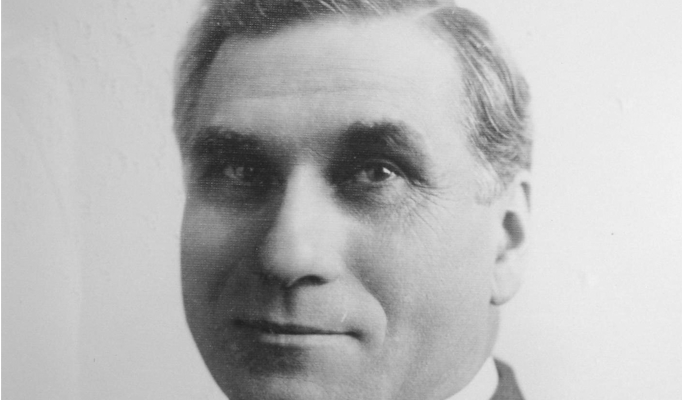
Menno Simons (1496 –1561) grew up in poverty as a peasant in Friesland, Holland. At an early age, he was enrolled in a monastic school, possibly at the Franciscan monastery in Bolsward, to prepare for the Catholic priesthood. In March 1524, at the age of 28, he was ordained at Utrecht and assigned to the parish at Pingjum, near the place of his birth. Seven years later in 1531, he became the village priest in his home parish at Witmarsum. Simons learned Latin and some Greek, but never read the Bible out of fear that it would lead him into heresy. Instead, he did a lot of cardplaying and drinking as the parish priest. He commented: “Finally I got the idea to examine the New Testament carefully.” After reading Luther’s books, Menno became known as an evangelical preacher because he began preaching from the bible. Menno Simon’s favorite bible verse was 1 Corinthians 3:11 “No one can lay any other foundation than that which is laid, Jesus Christ.” Luther never met Menno Simons and didn’t appreciate Anabaptists.
Menno’s first exposure to ‘rebaptism’ came when he heard of Sicke Snijde’s beheading following his adult baptism. The idea of believer’s baptism initially ‘seemed very strange’ to Menno as he had baptized his churchgoers only as infants.
I saw that these zealous children, though in error, willingly gave their lives and their estates for their doctrine and faith…But I myself continued in my comfortable life and acknowledged abominations simply in order that I might enjoy comfort and escape the cross of Christ.
Seeing Munster as the apocalyptic New Jerusalem, the Munsterites had embraced polygamy and forced people to be rebaptized on pain of death. This shocked Menno and so he denounced the Munsterites and embraced non-violence:
The regenerated do not go to war, nor engage in strife. They are children of peace who have beaten their swords into plowshares and their spears into pruning forks.
We are called, said Menno, to be a church of peace:
True Christians do not know vengeance. They are the children of peace. Their hearts overflow with peace. Their mouths speak peace and they walk in the way of peace.
Menno was careful, thoughtful, and reflective, a welcome contrast to the more extreme Munsterite Anabaptists. When Menno Simons became an Anabaptist on January 12th 1536, he joined a movement in dangerous peril. Almost all of its initial leaders were dead, either by disease (Conrad Grebel) or execution (Felix Manz, Michael Sattler, Hans Hut, Hans Denck, Balthasar Hubmaier, Georg Blaurock, and Jakob Hutter). Melchior Hoffman who brought Anabaptism to the Netherlands was in prison. Anabaptist leaders usually died within two to three years.
The authorities conveniently lumped the Munsterites and the peaceful Anabaptists together. Baptist historian William Estep suggested that the history of Anabaptists can be divided into three periods: “before Menno, under Menno, and after Menno.” His decision to get rebaptized was very costly:
I prayed to God with sighs and tears that He would give to me, a sorrowing sinner, the gift of His grace, create within me a clean heart, and graciously through the merits of the crimson blood of Christ, He would graciously forgive my unclean walk and unprofitable life.
After Menno’s rebaptism in 1536, he became a fugitive. He spent a year in hiding, seeking God’s direction for his new ministry. During this time, he wrote Van de geestlijke verrijsenisse (“The Spiritual Resurrection”), De nieuwe creatuere (“The New Birth”), and Christelycke leringhen op den 25. Psalm (“Meditation on the Twenty-fifth Psalm”). More than forty of his writings survived.
In 1537, he was ordained by the Anabaptist leader Obbe Phiips, and married Gertrude. They had three children, two daughters and a son. Only one daughter outlived him.
Many, including Herman and Gerryt Jansz, were arrested, charged and beheaded for having taken Simons as a lodger. In 1544, Jan Claess’ head was cut off on Amsterdam’s Dam Square and stuck on a stake; his body was placed on a wheel to be eaten by animals and birds. His crimes included rebaptism by Menno and publication in Antwerp of about 600 copies of Menno’s books. In 1549, Elisabeth Dirks, was arrested on suspicion of being Menno’s wife (she wasn’t), endured imprisonment, inquisition, torture, and finally death.
Menno taught the Mennonites, in the spirit of the Sermon on the Mount, to value simplicity and avoid pride:
I voluntarily renounced all my worldly honor and reputation…and at once willingly submitted to distress and poverty, and the cross of Christ.
In 1542, the Holy Roman emperor Charles V promised 100 guilders reward ($8,100 CDN) to bring about Menno’s arrest. In 1543, the Netherlands ordered the death sentence for anyone publishing, spreading, or reading Menno Simon’s work. Pardon of all crimes, and a hundred guilders, was promised in 1544 to criminals who could deliver Menno Simons to the government. Menno’s publisher John Claus was executed that following year. Around this time, the term ‘Mennist’ or ‘Mennonite’ came into use, a phrase that Menno tried unsuccessfully to discourage. In his later years, he often used crutches, calling himself ‘the lame’. Finally in 1544, the Simons found safe refuge in a Holstein cottage near Lubeck, Germany. After his peaceful death, he was buried in 1561 in his garden. In the 1550s, from 2,000 to 4,000 Mennonites were tortured, beheaded or buried alive. The many stories of the Mennonite martyrs are recorded in the 1660 Martyrs Mirror by Thieleman J. van Braght.
Menno sought to establish a believers’ New Testament Church. His desire to separate church from state was unusual in a time of state churches. He saw the church’s identity as a spotless bride ready for her coming husband. Mennonites often speak of being in the world, but not of it.
Menno’s pacifist convictions brought great suffering to his Mennonite followers who left Holland, then Prussia, then South Russia (Ukraine), and moved to Canada in order to say no to violence. Ukrainian Mennonites were often caught between a rock and a hard place as first the communists and then the nazis tried to break down their pacifism. While Canada initially promised military exemption and private schools in the language of choice, the government reneged on their educational promise, forcing Mennonite children to attend Public English schools. Over 7,000 Mennonites moved to Mexico and Paraguay because of this betrayal by the Saskatchewan and Manitoba governments. In 1920 to 1921, Canada banned Mennonites from entering Canada because of their unCanadian pacifist views. Then again from 1929 to 1945, Mennonites were not permitted to move to Canada.
A major theme of Menno’s writings is the new birth. He was strongly Christ-centered, desiring believers to not just talk the talk, but also walk the walk as new persons. Out of Menno’s deep suffering came a conviction of caring for other hurting people:
True evangelical faith … cannot lie dormant. … It clothes the naked, it feeds the hungry, it comforts the sorrowful, it shelters the destitute, it serves those that harm it … it binds up that which is wounded … it has become all things to all people.
Menno’s compassion has inspired the MCC (Mennonite Central Committee) to help millions, particularly those who are refugees. Matthew 25:35 has been described as the ‘national anthem’ of the Mennonites: “For I was hungry and you gave me something to eat, I was thirsty and you gave me something to drink, I was a stranger and you invited me in.” Many lost people first meet Jesus through the practical caring of Mennonites. Encouraged by Menno’s example, Mennonite communities regularly show the highest level of charitable giving in Canada.
Like their founder, Mennonites tend to be independently minded people. Life for Mennonites is often like a Mennonite patchwork quilt of joy and suffering. Because Mennonites fight with words rather than weapons, they have developed a rich body of literature exploring their history and identity. They remarkably turn tragedy into comedy with very dry humour and word-play.
We thank God for Menno Simons and his caring, peaceful and generous Mennonites who have made Canada a better place to live.





 Books by Rev. Dr. Ed & Janice Hird include God’s Firestarters; Blue Sky, a novel; and For Better, For Worse: Discovering the keys to a Lasting Relationship. Dr Ed’s newest award-winning book The Elisha Code is co-authored with Rev. David Kitz. Earlier books by Dr. Ed include the award-winning Battle for the Soul of Canada, and Restoring Health: Body, Mind, & Spirit.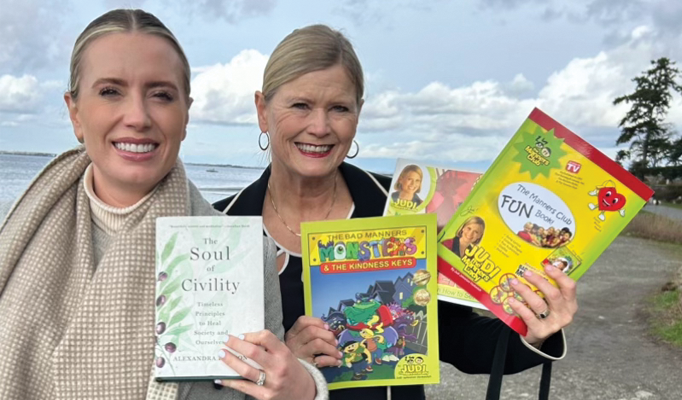

 Edhird's Blog