One of the best loved Christmas Carols is the 19th century carol: Good King Wenceslas. In 1853, John Mason Neale chose Wenceslas as the subject for a children’s song to exemplify generosity. It quickly became a Christmas favorite, even though its words clearly indicate that Wenceslas ‘looked out’ on St. Stephen’s Day, the day after Christmas. So Good King Wenceslas is actually a Boxing Day carol! For a tune, Neale picked up a spring carol, originally sung with the Latin text ‘Tempus adest floridum’ or ‘Spring has unwrapped her flowers’. This original spring tune was first published in 1582 in a collection of Swedish church and school songs.
Wenceslas was the Duke of Bohemia who was murdered in 929 AD by his wicked younger brother, Boleslav. As the song indicates, he was a good, honest, and strongly principled man. The song expresses his high moral character in describing King Wenceslas braving a fierce storm in order to help feed a poor neighbour. Wenceslas believed that his Christian faith needed to be put into action in practical ways. Wenceslas was brought up with a strong Christian faith by his grandmother St. Ludmila. Wenceslas’ own mother Drahomira, however, joined forces with an anti-Christian group that murdered Wenceslas’ grandmother, and seized power in Bohemia. Two years later in 922 AD, the evil Drahomira was deposed, and Good King Wenceslas became the ruler. He became Bohemia’s most famous martyr and patron saint. His picture appeared on Bohemian coins, and the Crown of Wenceslas became the symbol of Czech independence.
Even as a young child, I remember feeling moved as I sung this unusual carol. Why does Good King Wenceslas have such a deep and lasting impact on its hearers? Perhaps it is because there are so many levels of meaning to this carol. A child may hear one thing, an adult may hear another. I find that I can sing it again and again, and new meaning continues to pour forth from the carol. Recently the phrase ‘Fails my heart, I know not how, I can go no longer’ really spoke to me. It reminded me that sometimes there are times in our lives when life and its stresses seem to overwhelm us, and we feel that ‘we can go no longer.’ The response of Good King Wenceslas was most interesting. He said: ‘Mark my footsteps, my good page, Tread thou in them boldly: Thou shalt find the winter’s rage freeze thy blood less coldly.’ Wenceslas reminds us that when we are all alone, life can feel very bleak. It is at such times that solidarity with another human being can help ‘our blood freeze less coldly’. Wenceslas affirms that we are not alone, and subtly points to the basic Christmas message that Jesus our Master will never leave us in the cold.
In His Master’s Steps
In the last verse are the memorable words: ‘In his master’s steps he trod, where the snow lay dinted.’ The author John Neale, an Anglican priest, shows us here that the essence of true living is learning to walk in our Master’s steps. All of us need a Higher Power to help guide us along our journey. Jesus said: “If anyone would come after me (and tread in my steps), he must deny himself and take up his cross and follow me.” Our challenge each Christmas is to look beyond the toys and tinsel, to see ‘the Master’s steps.’
-previously published in the Deep Cove Crier/North Shore News
P. S. Click this Amazon link to view for free the first two chapters of our new novel Blue Sky.
“I’m afraid there’s been an accident…”
Sandy Brown and her family have just moved to Spokane, Washington where her husband, Scott, is pastoring a new church. With a fresh start, Sandy is determined to devote more time to her four children. But, within weeks of settling in their new life, the Brown family is plunged into turmoil.
Sandy receives shocking news that her children aren’t safe, which brings back haunting memories of the trauma she experienced as a girl. Then, the unthinkable happens…
A brutal attack puts Sandy on the brink of losing everything she’s loved. Her faith in God and the family she cherishes are pushed to the ultimate limit.
Is healing possible when so many loved ones are hurt? Are miracles really possible through the power of prayer? Can life return to the way it was before?
Blue Sky reveals how a mother’s most basic instinct isn’t for survival… but for family.
If you’re a fan of Karen Kingsbury, then you’ll love Blue Sky. Get your copy today on paperback or kindle.
-The sequel book Restoring Health: body, mind and spirit is available online with Amazon.com in both paperback and ebook form. Dr. JI Packer wrote the foreword, saying “I heartily commend what he has written.” The book focuses on strengthening a new generation of healthy leaders. Drawing on examples from Titus’ healthy leadership in the pirate island of Crete, it shows how we can embrace a holistically healthy life.
To receive a signed copy within North America, just etransfer at ed_hird@telus.net, giving your address. Cheques are also acceptable.
-Click to purchase the Companion Bible Study by Jan Cox (for the Battle of the Soul of Canada) in both paperback and Kindle on Amazon.com and Amazon.ca
-Click to purchase the Companion Bible Study by Jan Cox (for the Battle of the Soul of Canada) in both paperback and Kindle on Amazon.com and Amazon.ca
To purchase any of our six books in paperback or ebook on Amazon, just click on this link.
Ever since Coca-Cola decided to promote Santa Claus as part of their soft drink campaign, Santa or St. Nicholas became a household name in North America. Santa is from the Dutch word for Saint. Claus is again a Dutch contraction for Nicholas.
Do you remember back when John Lennon said that the Beatles were bigger than Jesus Christ? Do you remember the controversy? John, of course, was right. The Beatles were for a while more popular and more central for millions. So too is Santa Claus bigger than the baby Jesus at Christmas. As a young boy, St. Nicholas for me was the heart of Christmas. The fact that my mother insisted on dragging me to church on Christmas seemed to me like a horrible religious intrusion into an otherwise good holiday.
When I was 5 years old, though, I became suspicious when Santa kept appearing at all the different shopping centres. I calculated that no reindeer could fly that fast and be in so many places at once. Once I shared my conclusions with my five year old friends, I was amazed that some of my friends’ mothers were not as excited about my “findings” as I was!
Many years later I was surprised to discover that “yes Virginia, there really is a Santa Claus” History tells us that there was a real, live Santa Claus or St. Nicholas in the country of Turkey during the early 4th Century. St. Nicholas was the Bishop of Myra. He was a very faithful Christian who endured terrible suffering and imprisonment during the great persecution by the Roman Emperor Diocletian in 303 A.D.
During this time, many church buildings were destroyed, bibles were burnt, and priests were murdered. As a result of his faithful suffering, Nicholas ended up being made Saint, the Patron Saint of sailors, Russia, and children. His symbol became 3 bags of gold, the dowry he was supposed to have given to three girls to save them from embarrassment. That, of course, is the origin of Santa bringing presents at Christmas.
The musician Randy Stonehill wrote in a Christmas song that “I know that if St. Nicholas was here, he would agree that Jesus gave the greatest gift of all to you and me” It is quite clear that the real Santa Claus (Nicholas) loved Jesus very much, and was willing to suffer for his faith. I believe that if Santa Claus were here today, he would say “Don’t just leave Jesus in the Manger. Make room for Him in your heart, not only at Christmas, but all year round”
This Christmas may we all remember the words of that famous carol Oh Little Town of Bethlehem. “O Holy Child of Bethlehem descend to us, we pray. Cast out our sin and enter in, be born in us today..”
P. S. Click this Amazon link to view for free the first two chapters of our new novel Blue Sky.
“I’m afraid there’s been an accident…”
Sandy Brown and her family have just moved to Spokane, Washington where her husband, Scott, is pastoring a new church. With a fresh start, Sandy is determined to devote more time to her four children. But, within weeks of settling in their new life, the Brown family is plunged into turmoil.
Sandy receives shocking news that her children aren’t safe, which brings back haunting memories of the trauma she experienced as a girl. Then, the unthinkable happens…
A brutal attack puts Sandy on the brink of losing everything she’s loved. Her faith in God and the family she cherishes are pushed to the ultimate limit.
Is healing possible when so many loved ones are hurt? Are miracles really possible through the power of prayer? Can life return to the way it was before?
Blue Sky reveals how a mother’s most basic instinct isn’t for survival… but for family.
If you’re a fan of Karen Kingsbury, then you’ll love Blue Sky. Get your copy today on paperback or kindle.
-The sequel book Restoring Health: body, mind and spirit is available online with Amazon.com in both paperback and ebook form. Dr. JI Packer wrote the foreword, saying “I heartily commend what he has written.” The book focuses on strengthening a new generation of healthy leaders. Drawing on examples from Titus’ healthy leadership in the pirate island of Crete, it shows how we can embrace a holistically healthy life.
To receive a signed copy within North America, just etransfer at ed_hird@telus.net, giving your address. Cheques are also acceptable.
-Click to purchase the Companion Bible Study by Jan Cox (for the Battle of the Soul of Canada) in both paperback and Kindle on Amazon.com and Amazon.ca
-Click to purchase the Companion Bible Study by Jan Cox (for the Battle of the Soul of Canada) in both paperback and Kindle on Amazon.com and Amazon.ca
To purchase any of our six books in paperback or ebook on Amazon, just click on this link.
Beethoven once said: “Handel was the greatest composer that ever lived. I would uncover my head, and kneel before his tomb.” King George III called Handel “the Shakespeare of Music.” George Bernard Shaw commented that “Handel is not a mere composer in England: he is an institution. What is more, he is a sacred institution.”
In North America and England, at the very least, Handel’s Messiah has become the most popular and performed and recorded and listened to choral work. Many people stereotype Handel’s Messiah as Christmas music, but in earlier years, Messiah performances were more likely to occur at Easter. For Handel, the Messiah was an Easter event that told not merely of birth but also of death and resurrection.
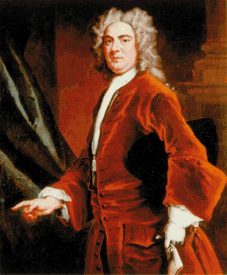
George Frideric Handel was born in Halle, Germany within a month of Johanne Sebastian Bach (1685). Handel’s father was a barber-surgeon who hated music and wanted his son to become a successful lawyer. His aunt Anna gave Handel a spinet harpsichord that they hid in Handel’s attic, wrapping each string with thin strips of cloth, so that Handel could play undetected.
When George was eight or nine, the Duke of Weissenfels heard him play the postlude to a church service and he summoned the boy’s father and told him he ought to encourage such talent. His only teacher was Friedrich Wilhelm Zachow, a most learned and imaginative musician and teacher, who instilled in his young pupil a lifelong intellectual curiosity. At age 11, Handel entered a musical contest at the Berlin court of the Elector with the famous composer Buononcini, and won.
When Handel moved to England in 1712, it was a beehive of musical activity with Italian opera ruling the day. Within the next 30 year period in England, Handel wrote about 40 operas and 26 oratorios. Handel did not play to easy audiences. If opera attenders felt bored in Handel’s day, they would often start loud conversations, and walk around freely. It was also a custom for them to play cards, and eat snacks right during the opera.
As Smith/Carlson put it, Handel “…was an inviting target for critics and for satire. He was a foreigner, and an individual no one could help noticing. He had large hands, large feet, a large appetite, and he wore a huge white wig with curls rippling over his shoulders. He spoke English rather loudly in a colourful blending of Italian, German, and French. He was temperamental, he loved freedom, and he hated restrictions which placed limits on his art…”
Charles Burney, who later sang and played under him, told how Handel once raged at him when he made a mistake, “a circumstance very terrific to a young musician.” But when Handel found that his mistake was caused by a copying error, he apologized generously (“I pec your parton – I am a very odd tog”, he said in Germanic English).
Handel also struggled with his weight, a problem about which critics mercilessly teased him. His London years were up and down, and unbelievably down at times. As Romain Rolland has tried to explain it: “He was surrounded by a crowd of bulldogs with terrible fangs, by unmusical men of letters who were likewise able to bite, by jealous colleagues, arrogant virtuosos, cannibalistic theatrical companies, fashionable cliques, feminine plots, and nationalistic leagues…Twice he was bankrupt, and once he was stricken by apoplexy amid the ruin of his company. But he always found his feet again; he never gave in.”
The situation was so bleak in 1741 that just before he wrote the Messiah, he had seriously considered going back to Germany. But instead of giving up, he turned more strongly to God. Handel composed the Messiah in 24 days without once leaving his house. During this time, his servant brought him food, and when he returned, the meal was often left uneaten. While writing the “Hallelujah Chorus”, his servant discovered him with tears in his eyes. He exclaimed, “I did think I did see all Heaven before me, and the great God Himself!!” As Newman Flower observes, “Considering the immensity of the work, and the short time involved in putting it to paper, it will remain, perhaps forever, the greatest feat in the whole history of musical composition.”
At a Messiah performance in 1759, honouring his seventy-fourth birthday, Handel responded to enthusiastic applause with these words: “Not from me – but from Heaven- comes all.” In his last years he worshipped twice every day at St. George’s Church, Hanover Square, near his home.
The Messiah was first performed in Dublin in 1742, and immediately won huge popular success. In order to have room enough for the people, a request was sent afar and wide, asking, “The favour of the Ladies not to come with hoops this day to the Music Hall in Fishamble Street. The Gentlemen are desired to come without their swords.” This is how the Dublin Newspaper reported the event: “…The best Judges allowed it to be the most finished work of Musick. Words are wanting to express the exquisite Delight it afforded to the admiring crowded Audience. The Sublime, the Grand, and the Tender, adapted to the most elevated, majestic, and moving Words, conspired to transport and charm the ravished Heart and Ear…” Handel could have made a financial killing from the Messiah, but instead he designated that all the proceeds would go to charities.
In contrast to the Irish, the English did not initially like the Messiah. This oratorio, after all, had no story. The soloists had too little to do, and the chorus too much. It was different, and the audience wasn’t ready for it. Jennens who wrote the script didn’t like it either. He commented: “Handel’s Messiah has disappointed me, being set in great haste, though he said he would be a year about it, and make it the best of all his Compositions. I shall put no more Sacred Works into his hands, thus to be abused.”
Twenty-five years later, Handel’s Messiah was so popular with the English that they almost rioted, while waiting to hear it at Westminster Abbey. People screamed, as they feared being trampled. Others fainted. Some threatened to break down the church doors.
Handel’s use of biblical words in a theatre was revolutionary, and those who opposed Handel went to great extremes to keep his oratorios from being successful. For example, certain self-righteous women gave large teas or sponsored other theatrical performances on the days when Handel’s concerts were to take place in order to rob him of an audience. As well, his enemies hired boys to tear down the advertisements about Handel’s Messiah. One opponent wrote to a newspaper asking “if the Playhouse is a fit Temple…or a Company of Players fit Ministers of God’s Word.” This person saw the Messiah as “prostituting sacred things to the perverse humour of a Set of obstinate people.”
In contrast, the famous preacher John Wesley liked Handel’s Messiah. He wrote: “In many parts, especially several of the choruses, it exceeded my expectation.” One clergy William Hanbury in 1759 said that you could hardly find an eye without tears in the whole audience.
The King was so deeply stirred with the exultant music, that when the first Hallelujah rang through the hall, he rose to his feet and remained standing until the last note of the chorus echoed through the house. From this began the custom of standing for the Hallelujah chorus. When a nobleman praised Handel as to how entertaining the Messiah was, Handel replied, “My Lord, I should be sorry if I only entertained them; I wished to make them better.”
What is it about the Messiah that makes it so popular? Many scholars point to the spaciousness in Handel’s music, the dramatic silences, and the stirring contrast. Sadie commented that the music of Handel’s, is a blend of different styles: English church music (especially the choruses), the German Passion-music tradition, the Italian melodic style. In fact, three of the choruses are arranged from Italian love-duets which Handel had written thirty years before. Handel’s genius was in bringing new and dramatic twists to the familiar and mundane.
In 1759 the almost blind Handel conducted a series of 10 concerts. After performing the Messiah, he told some friends that he had one desire –to die on Good Friday. “I want to die on Good Friday,” he said, “in the hope of rejoining the good God, my sweet Lord and Saviour, on the day of His resurrection.”
On Good Friday, he bid good-bye to his friends and dies the very next day on Holy Saturday, April 14th, 1759. Handel was fittingly buried in Poet’s Corner at Westminster Abbey. A close friend of Handel’s, James Smyth, said: “Handel died as he lived –as a good Christian, with a true sense of his duty to God and man, and in perfect charity with all the world…”
My prayer is that the words and music of Handel’s Messiah may help us experience the intimacy of Handel’s relationship with His Messiah, Jesus of Nazareth.
-previously published in the Deep Cove Crier/North Shore News
P. S. Click this Amazon link to view for free the first two chapters of our new novel Blue Sky.
“I’m afraid there’s been an accident…”
Sandy Brown and her family have just moved to Spokane, Washington where her husband, Scott, is pastoring a new church. With a fresh start, Sandy is determined to devote more time to her four children. But, within weeks of settling in their new life, the Brown family is plunged into turmoil.
Sandy receives shocking news that her children aren’t safe, which brings back haunting memories of the trauma she experienced as a girl. Then, the unthinkable happens…
A brutal attack puts Sandy on the brink of losing everything she’s loved. Her faith in God and the family she cherishes are pushed to the ultimate limit.
Is healing possible when so many loved ones are hurt? Are miracles really possible through the power of prayer? Can life return to the way it was before?
Blue Sky reveals how a mother’s most basic instinct isn’t for survival… but for family.
If you’re a fan of Karen Kingsbury, then you’ll love Blue Sky. Get your copy today on paperback or kindle.
-The sequel book Restoring Health: body, mind and spirit is available online with Amazon.com in both paperback and ebook form. Dr. JI Packer wrote the foreword, saying “I heartily commend what he has written.” The book focuses on strengthening a new generation of healthy leaders. Drawing on examples from Titus’ healthy leadership in the pirate island of Crete, it shows how we can embrace a holistically healthy life.
To receive a signed copy within North America, just etransfer at ed_hird@telus.net, giving your address. Cheques are also acceptable.
-Click to purchase the Companion Bible Study by Jan Cox (for the Battle of the Soul of Canada) in both paperback and Kindle on Amazon.com and Amazon.ca
-Click to purchase the Companion Bible Study by Jan Cox (for the Battle of the Soul of Canada) in both paperback and Kindle on Amazon.com and Amazon.ca
To purchase any of our six books in paperback or ebook on Amazon, just click on this link.

 By the Rev. Dr. Ed Hird
 murdered in 929 AD by his wicked younger brother, Boleslav. As the song indicates, he was a good, honest, and strongly principled man. The song expresses his high moral character in describing King Wenceslas braving a fierce storm in order to help feed a poor neighbour. Wenceslas believed that his Christian faith needed to be put into action in practical ways. Wenceslas was brought up with a strong Christian faith by his grandmother St. Ludmila. Wenceslas’ own mother Drahomira, however, joined forces with an anti-Christian group that murdered Wenceslas’ grandmother, and seized power in Bohemia. Two years later in 922 AD, the evil Drahomira was deposed, and Good King Wenceslas became the ruler. He became Bohemia’s most famous martyr and patron saint. His picture appeared on Bohemian coins, and the Crown of Wenceslas became the symbol of Czech independence.
 times that solidarity with another human being can help ‘our blood freeze less coldly’. Wenceslas affirms that we are not alone, and subtly points to the basic Christmas message that Jesus our Master will never leave us in the cold.
 Sandy Brown and her family have just moved to Spokane, Washington where her husband, Scott, is pastoring a new church. With a fresh start, Sandy is determined to devote more time to her four children. But, within weeks of settling in their new life, the Brown family is plunged into turmoil.






 When George was eight or nine, the Duke of Weissenfels heard him play the postlude to a church service and he summoned the boy’s father and told him he ought to encourage such talent. His only teacher was Friedrich Wilhelm Zachow, a most learned and imaginative musician and teacher, who instilled in his young pupil a lifelong intellectual curiosity. At age 11, Handel entered a musical contest at the Berlin court of the Elector with the famous composer Buononcini, and won.
 The situation was so bleak in 1741 that just before he wrote the Messiah, he had seriously considered going back to Germany. But instead of giving up, he turned more strongly to God. Handel composed the Messiah in 24 days without once leaving his house. During this time, his servant brought him food, and when he returned, the meal was often left uneaten. While writing the “Hallelujah Chorus”, his servant discovered him with tears in his eyes. He exclaimed, “I did think I did see all Heaven before me, and the great God Himself!!” As Newman Flower observes, “Considering the immensity of the work, and the short time involved in putting it to paper, it will remain, perhaps forever, the greatest feat in the whole history of musical composition.”
 Edhird's Blog