For thirty years from 1987 to 2018, I was a monthly columnist in the North Shore News/Deep Cove Crier. I was always praying about some topic that people can really get their teeth into.
Sitting in a Deep Cove dental chair gave me time to reflect on my next article. As the dental hygienist was scraping and pulling and prodding, I began to reflect on the significance and priority of our teeth. Teeth are unforgiving. You either look after them carefully, or they strike back in all kinds of unpleasant ways. Just talk to your friends who have had a failed root-canal operation. Even in these days of hi-tech painkillers, toothaches still ache.
I literally sat in Deep Cove dental chairs for thirty years. Every six months or so, I received the obligatory call from Dr. Mangat’s dental office. I thank God for a good dental plan! Dr. Mangat told me that one of the things that attracted him to relocate to the Cove is that ‘village’ sense that still exists in our community.
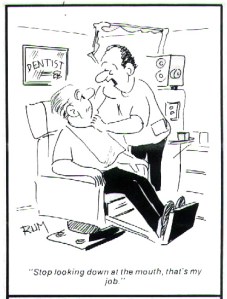
The term ‘down in the mouth’ means to be low in spirits, downcast, or depressed. A number of North Shore residents report feeling more depressed during the winter because of all the rain. There is a perception out there that dentists suffer more from depression and even suicide. In chatting with my dentist Dr. Mangat, he told me that the higher dental suicide issue is likely a myth. Roger E. Alexander, D.D.S., of the Baylor College of Dentistry, recently examined this stereotype. Alexander found data suggesting that female dentists may be more vulnerable to suicide, but unearthed no evidence that dentists take their own lives with greater frequency than the general population. “What we know about suicide in dentistry is based on weak data from the early 1970s, involving mostly white males” says Alexander, who called for additional research in the Journal of the American Dental Association. My sense is that there is a lot of pressure on dentists as they not only have to be technically competent, but also very skilled at running small businesses.
For the last sixty-five years of my life, I have been fighting the good fight, dentally speaking. My parents spent thousands of dollars on dental surgery and braces for me. I remember when a bully at Oak Park knocked me off my Peugeot bike and proceeded to stomp on my head with his boots. Having no idea what he was upset about, I naively said: “Can we talk about this?” When he grunted “no”, I realized that I was in serious trouble. I was about to either lose face emotionally or lose face literally, which would mean that my multi-thousand dollar smile was about to disappear. Being more afraid of my parent’s wrath over my braces than of the bully, I jumped on my Pugeot and rode off. This was one of the wisest dental decisions that I ever made, especially as I heard later that this bully later had his teeth kicked in and a broken beer bottle twisted in his face.
As a teenager, I felt very embarrassed by my braces, and later by my retainer which made it hard to communicate. My math teacher in Grade 10 actually thought that I was swearing at her when I was only answering a math question while wearing my retainer. She was not pleased! You may have notice that teenage peers can be ruthless in their affectionate terms for those who are dentally-challenged: brace face, metal mouth, tinsel teeth, etc. But three decades late, I am so grateful for the investment my parents made in me. Dentures just don’t compare to one’s own genuine teeth.
I used to hate flossing. Gradually I began to grudgingly admit the need. My thought of a helpful compromise was to only floss on the day that I went to the dentist. As I sat in the dentist’s office with bleeding gums, my compromise somehow did not impress them. I am now a passionate flosser who tries to convert other people to the ‘redemptive’ benefits of removing plaque. It occurred to me recently that many people view flossing and going to the dentist similarly to the idea of attending church. They may acknowledge that it might be good for them, but it is certainly not something to which they are looking forward. There are too many painful memories or alternately fear of the unknown. Many young people nowadays, unlike the baby-boomers or seniors, have never been to a church service once in their life.
Dentists want to make a difference in other people. Many are inspired by the Golden Rule. There is spirituality to dentistry that potentially involves the whole person, body, mind and spirit. My prayer is that we may all show that same love to each other so that none of us will remain down in the mouth.
The Rev. Dr. Ed Hird, BSW, MDiv, DMin
-previously published in the North Shore News/Deep Cove Crier
P. S. Click this Amazon link to view for free the first two chapters of our new novel Blue Sky.
“I’m afraid there’s been an accident…”
Sandy Brown and her family have just moved to Spokane, Washington where her husband, Scott, is pastoring a new church. With a fresh start, Sandy is determined to devote more time to her four children. But, within weeks of settling in their new life, the Brown family is plunged into turmoil.
Sandy receives shocking news that her children aren’t safe, which brings back haunting memories of the trauma she experienced as a girl. Then, the unthinkable happens…
A brutal attack puts Sandy on the brink of losing everything she’s loved. Her faith in God and the family she cherishes are pushed to the ultimate limit.
Is healing possible when so many loved ones are hurt? Are miracles really possible through the power of prayer? Can life return to the way it was before?
Blue Sky reveals how a mother’s most basic instinct isn’t for survival… but for family.
If you’re a fan of Karen Kingsbury, then you’ll love Blue Sky. Get your copy today on paperback or kindle.
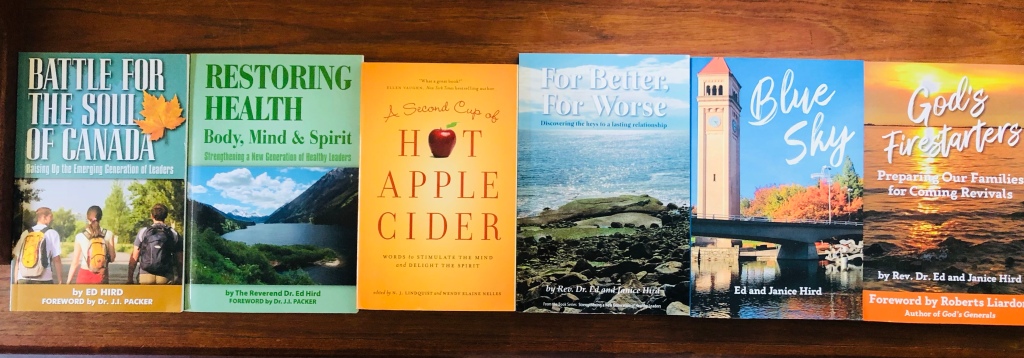
-The sequel book Restoring Health: body, mind and spirit is available online with Amazon.com in both paperback and ebook form. Dr. JI Packer wrote the foreword, saying “I heartily commend what he has written.” The book focuses on strengthening a new generation of healthy leaders. Drawing on examples from Titus’ healthy leadership in the pirate island of Crete, it shows how we can embrace a holistically healthy life.
To receive a signed copy within North America, just etransfer at ed_hird@telus.net, giving your address. Cheques are also acceptable.
-Click to purchase the Companion Bible Study by Jan Cox (for the Battle of the Soul of Canada) in both paperback and Kindle on Amazon.com and Amazon.ca
-Click to purchase the Companion Bible Study by Jan Cox (for the Battle of the Soul of Canada) in both paperback and Kindle on Amazon.com and Amazon.ca
To purchase any of our six books in paperback or ebook on Amazon, just click on this link.
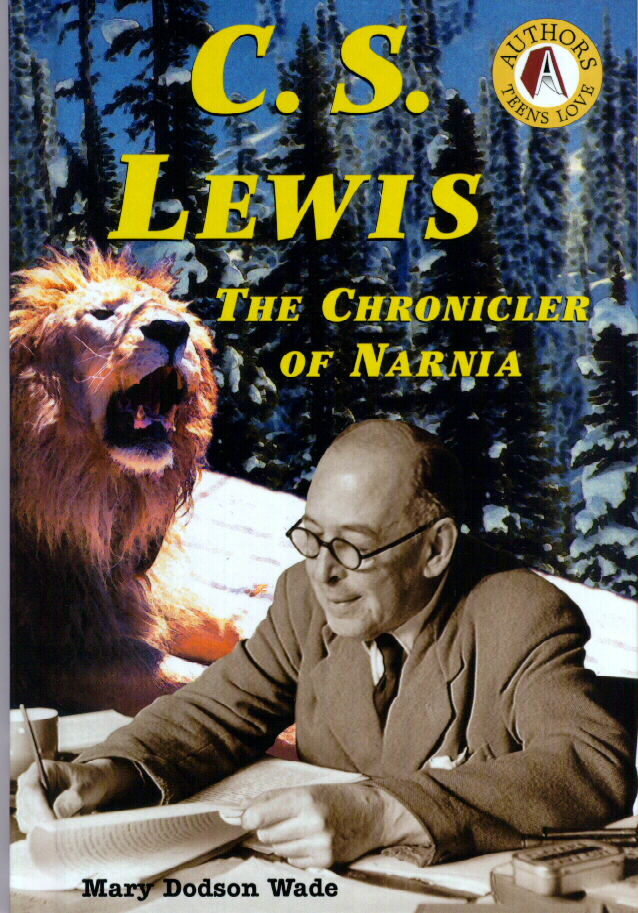
At age 10, Lewis saw his mother dying of cancer. “With my mother’s death”, said Lewis, “all that was tranquil and reliable, disappeared from my life.” Tolkien experienced the double loss of both his father at age 3 and his mother at age 12. Tolkien’s strong desire for friendship/fellowship, as with Frodo, Sam, Merry & Pippin, came from Tolkien’s loss of his three best friends in the trenches. Referring to trench warfare, CS Lewis commented: “Through the winter, weariness and water were our chief enemies. I have gone to sleep marching and woken again and found myself marching still.” Lewis vividly remembered “the frights, the cold,…the horribly smashed men still moving like half-crushed beetles, the sitting or standing corpses, the landscape of sheer earth without a blade of grass, the boots worn day and night until they seemed to grow to your feet…”Anthony Hopkins portrayed CS (Jack) Lewis, the author of the hugely popular Narnia Tales, in the thoughtful movie ‘Shadowlands’. Since Lewis’ death in 1963, sales of his books have risen to over 2 million a year. For much of his life, Lewis, the son of a solicitor and of an Anglican clergyman’s daughter, was a convinced atheist. While teaching at Oxford College, Lewis formed a lasting friendship with JRR Tolkien. Both Lewis and Tolkien had much in common, as both had been traumatized by the premature death of their mothers and by the horrors of trench warfare in World War I.
Both CS Lewis and Tolkien loved the history of the English language, especially as expressed in the ancient tales like Beowulf. CS Lewis commented: “When I began teaching for the English Faculty, I made two other friends, both Christians (those queer people seemed to pop up on every side) who were later to give me much help in getting over the last stile/steps. They were HVD Dyson and JRR Tolkien. Friendship with the latter marked the breakdown of two old prejudices…” Lewis said to Tolkien that tales or myths are ‘lies and therefore worthless, even though breathed through silver’. ‘No’, said Tolkien, ‘they are not lies’. Tolkien went on to explain to Lewis that in Jesus Christ, the ancient stories or myths of a dying and rising God entered history and became fact. Twelve days later, Lewis wrote to another friend Arthur Greeves: “I have just passed on from believing in God to definitely believing in Christ – in Christianity. I will try to explain this another time. My long night talk with Dyson and Tolkien had a good deal to do with it”.
CS Lewis recalls going by motorcycle with his brother Warren to Whipsnade Zoo, about thirty miles east of Oxford. “When we set out, I did not believe that Jesus Christ is the Son of God, and when we reached the zoo, I did”. In his autobiography Surprised by Joy, Lewis commented: “In the Trinity term of 1929 I gave in, and admitted that God was God…perhaps the most dejected and reluctant convert in all England”.
When CS Lewis turned to Christ, he was surprised to find the skies bluer and the grass greener.* “Today”, Lewis wrote, “I got such a sudden intense feeling of delight that it sort of stopped me in my walk and spun me round. Indeed the sweetness was so great, and seemed so to affect the whole body as well as the mind, that it gave me pause.” Lewis commented: “I really seem to have had youth given back to me lately.”
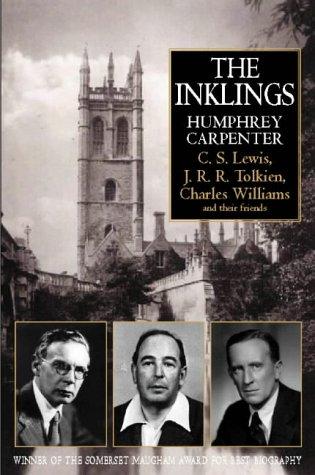
Lewis and Tolkien formed an ‘Inklings’ group at Oxford in which they read out and critiqued each other’s manuscripts like ‘Narnia Tales’ and ‘Lord of the Rings’. Lewis’ brother Warren said that at the Inklings, “the fun would be riotous with Jack at the top of his form and enjoying every minute…an outpouring of wit, nonsense, whimsy, dialectical swordplay, and pungent judgement such as I have rarely heard equaled…” The Inklings group was a clear example of that ancient Proverb “As iron sharpens iron, so one man sharpens another”.
Charles Williams, another author and member of the Inklings group, commented that “much was possible to a man in solitude, but some things were possible only to a man in companionship, and of these, the most important was balance. No mind was so good that it did not need another mind to counter it and equal it and to save it from conceit and bigotry and folly.” In October 1933, Tolkien wrote in his diary that friendship with Lewis ‘besides giving constant pleasure and comfort, has done me much good from the contact with a man at once honest, brave, intellectual – a scholar, a poet, and a philosopher – and a lover, at least after a long pilgrimage, of our Lord’.
The internationally respected Vancouver author, Dr. JI Packer, says that ‘the combination within CS Lewis of insight with vitality, wisdom with wit, and imaginative power with analytical precision made him a sparkling communicator of the everlasting gospel.’ At bottom, says Dr. Packer, Lewis was a mythmaker. As Austin Farrer commented of Lewis’ writings, “we think we are listening to an argument; in fact, we are presented with a vision; and it is the vision that carries conviction.” Myth, says Dr. Packer, is perhaps best defined as a story that projects a vision of life of actual or potential communal significance by reason of the identity and attitudes that it invites us to adopt.
When Tolkien first shared his ‘Lord of the Rings’ manuscript at the Inklings group, CS Lewis said: ‘This book is a lightning from a clear sky. Not content to create his own story, he creates with an almost insolent prodigality the whole world in which it is to move; with its own theology, myths, geography, history, paleography, languages and order of beings.’ Recent polls have consistently declared that Tolkien is the most influential author of the last 100 years and that the Lord of the Rings is the book of this recent century. Without the Inklings fellowship of Tolkien and Lewis, neither the Narnia Tales nor the Lord of the Rings might have ever seen the light of day. I thank God for the faithful Christian friendship of two pilgrims on a Quest.
*For more information on C.S. Lewis’ Joy, just click.
P. S. Click this Amazon link to view for free the first two chapters of our new novel Blue Sky.
“I’m afraid there’s been an accident…”
Sandy Brown and her family have just moved to Spokane, Washington where her husband, Scott, is pastoring a new church. With a fresh start, Sandy is determined to devote more time to her four children. But, within weeks of settling in their new life, the Brown family is plunged into turmoil.
Sandy receives shocking news that her children aren’t safe, which brings back haunting memories of the trauma she experienced as a girl. Then, the unthinkable happens…
A brutal attack puts Sandy on the brink of losing everything she’s loved. Her faith in God and the family she cherishes are pushed to the ultimate limit.
Is healing possible when so many loved ones are hurt? Are miracles really possible through the power of prayer? Can life return to the way it was before?
Blue Sky reveals how a mother’s most basic instinct isn’t for survival… but for family.
If you’re a fan of Karen Kingsbury, then you’ll love Blue Sky. Get your copy today on paperback or kindle.
-The sequel book Restoring Health: body, mind and spirit is available online with Amazon.com in both paperback and ebook form. Dr. JI Packer wrote the foreword, saying “I heartily commend what he has written.” The book focuses on strengthening a new generation of healthy leaders. Drawing on examples from Titus’ healthy leadership in the pirate island of Crete, it shows how we can embrace a holistically healthy life.
To receive a signed copy within North America, just etransfer at ed_hird@telus.net, giving your address. Cheques are also acceptable.
-Click to purchase the Companion Bible Study by Jan Cox (for the Battle of the Soul of Canada) in both paperback and Kindle on Amazon.com and Amazon.ca
-Click to purchase the Companion Bible Study by Jan Cox (for the Battle of the Soul of Canada) in both paperback and Kindle on Amazon.com and Amazon.ca
To purchase any of our six books in paperback or ebook on Amazon, just click on this link.


 The term ‘down in the mouth’ means to be low in spirits, downcast, or depressed. A number of North Shore residents report feeling more depressed during the winter because of all the rain. There is a perception out there that dentists suffer more from depression and even suicide. In chatting with my dentist Dr. Mangat, he told me that the higher dental suicide issue is likely a myth. Roger E. Alexander, D.D.S., of the Baylor College of Dentistry, recently examined this stereotype. Alexander found data suggesting that female dentists may be more vulnerable to suicide, but unearthed no evidence that dentists take their own lives with greater frequency than the general population. “What we know about suicide in dentistry is based on weak data from the early 1970s, involving mostly white males” says Alexander, who called for additional research in the Journal of the American Dental Association. My sense is that there is a lot of pressure on dentists as they not only have to be technically competent, but also very skilled at running small businesses.
 As a teenager, I felt very embarrassed by my braces, and later by my retainer which made it hard to communicate. My math teacher in Grade 10 actually thought that I was swearing at her when I was only answering a math question while wearing my retainer. She was not pleased! You may have notice that teenage peers can be ruthless in their affectionate terms for those who are dentally-challenged: brace face, metal mouth, tinsel teeth, etc. But three decades late, I am so grateful for the investment my parents made in me. Dentures just don’t compare to one’s own genuine teeth.
 Dentists want to make a difference in other people. Many are inspired by the Golden Rule. There is spirituality to dentistry that potentially involves the whole person, body, mind and spirit. My prayer is that we may all show that same love to each other so that none of us will remain down in the mouth.
 Sandy Brown and her family have just moved to Spokane, Washington where her husband, Scott, is pastoring a new church. With a fresh start, Sandy is determined to devote more time to her four children. But, within weeks of settling in their new life, the Brown family is plunged into turmoil.



 Edhird's Blog