Edhird's Blog

Restoring Health: body, mind and spirit


Leave a comment

Catharine Parr Traill: Pioneer Canadian Mother

By the Rev. Dr.  Ed Hird

Catharine Parr Traill was a pioneer Canadian mother who made a phenomenal impact on the life of our nation.

England in the early 1830s was caught in a Canada-mania.  In the aftermath of the Napoleonic wars, England was thrown into an economic depression.  Thomas Strickland, the father of Catherine Parr Traill, was caught in the economic downturn, resulting in near-bankruptcy and his premature death.  He left behind an impoverished widow and six unmarried daughters whose chances of marriage were seriously limited.

Both Catherine Parr Traill and her sister Susanna married economically-challenged Scottish soldiers who were offered land grants in the colonies.  Canada began to be seen as the land of milk and honey!  Altogether 655,747 people sailed away from British shores between 1831 and 1841 (almost three times as many as had moved abroad during the previous ten years).

The two key Canada-promoters William Cattermole and Captain Charles Stuart were being paid so much per head for every Brit that they could recruit for Canada.  In their glowing description of Canada, Cattermole and Stuart forgot to mention the backbreaking work required to clear the forests, the total absence of household comforts, the aching loneliness, and the grinding poverty of most early Canadian pioneers.  Catharine Parr Traill and her sister Susanna, being gifted writers, were able to record a vital part of our Canadian pioneering history.  In Catherine Parr Traill’s book ‘The Canadian Settler’s Guide’, she insightfully wrote:

“In cases of emergency, it is folly to fold up one’s hands and sit down to bewail in abject terror: it is better to be up and doing.”

Catharine’s book The Backwoods of Canada quickly sold its first printing of eleven thousand copies, being translated into German in 1838 and French in 1843.

Of the six Strickland daughters including Catherine, five of them became published authors!  Catharine’s older sister Agnes in England was the leading royal biographer of the 19th century.  Sister Agnes caustically commented: “Who in England thinks anything of Canada?” and “Nothing that is first published in Canada will sell well in England”.

 In Charlotte Grey’s book Sisters in the Wilderness, Catharine Parr Traill and her sister Susanna are described as laying “the foundation of a literary tradition that still endures in Canada: the pioneer woman who displays extraordinary courage, resourcefulness and humour.  This ‘Canadian character type’, as critic Elizabeth Thompson calls her, is a pragmatist who discovers her own strength as she overcomes adversity.”  Sir Sandford Fleming, inventor of one-hour time zones, and the engineering genius behind the Canadian Pacific Railway, said of Catharine: “She has rendered service of no ordinary kind in making known the advantages offered by Canada as a field for settlement, and by her very widely read writings she has been instrumental in inducing very many emigrants from the United Kingdom to find homes in the Dominion.”

Catharine Parr Trail had a remarkable ability to rise above adversity and make the best of every situation.  Charlotte Grey: writes in her book about ‘the stamina, talent and determination that allowed two English ladies to overcome the hardships of pioneer life and leave a powerful legacy to Canadian culture.’  It is hard for us almost two hundred years later to fully imagine the miseries of hunger, disease, cold, and disappointment faced by our early Canadian pioneers.  I was shocked to discover that both Catharine and her sister’s families came down with malaria, a widespread problem in Canada as pioneers were struggling to drain mosquito-infested swamps.

Catharine Parr Traill commented in the early days: “I have not seen a woman except those in our company for over five months….”  As Charlotte Grey put it, “Being wrenched from one’s homeland leaves deep scars in the psyche of every emigrant in any era:  Susanna and Catharine bore these scars for the rest of their lives.”

Catharine’s motto was ‘Hope! Resolution! And Perseverance!’.  She would assure her relatives back home that Canada is the ‘land of hope.’ Her sister Sarah spoke of Catherine/Kate: “Her blue eyes always sparkled with happiness and curiosity about the world.  She had a warm smile and an air of stolid contentment, and even as a baby, Catharine ‘never cried like other children –indeed we used to say that Katie never saw a sorrowful day – for if anything went wrong, she just shut her eyes and the tears fell from under the long lashes and rolled down her cheeks like pearls into her lap.  We all adored her.”

 Charlotte Grey commented how Catharine loved “the wild and picturesque rocks, trees, hill and valley, wild-flowers, ferns, shrubs and moss and the pure, sweet scent of pines over all, breathing health and strength.”  Nature, for Catharine, was saturated with divine meaning – its splendor and concord displayed the authority and goodness of its Creator.  That is why Catharine wrote many “books that reflected sheer love of nature’s bounty and admiration in God’s handiwork.”  The flowers of the field, for her, were good reminders of the teachings of Christ.  Catherine often illustrated her dried specimens with biblical quotes, particularly from the Psalms or the book of Revelation.

Charlotte Grey commented that in future years, Catharine would rely on her love of nature, the beauties of which she saw as the expression of God’s will, to carry her through one disaster after another:
“Strength was always given to me when it was needed.” As she dug and weeded in the kitchen garden, or lifted heavy cast-iron pans of porridge from the stove, she would pause briefly, straighten her aching back, close her eyes and utter silent prayers.  She noted at the end of her life: “In great troubles and losses, God is very Good.”

In the midst of her very busy writing and pioneering, Catharine never neglected her family.  As Charlotte Grey put it, “Motherhood came as naturally to Catharine as breathing.  It was the most meaningful activity in her life.  She was always prepared to give more love than she took, and she saw no conflict between her family and her impulse to write.”

My prayer is that every mother reading this article would receive that same strength as Catharine Parr Traill in the challenges of life.

The Rev. Dr. Ed Hird, BSW, MDiv, DMin

-previously published in the North Shore News/Deep Cove Crier

-award-winning author of the book Battle for the Soul of Canada

“I’m afraid there’s been an accident…”

12bdf6ff-3021-4e73-bccd-bc919398d1a0-7068-0000031133e7b4d9Sandy Brown and her family have just moved to Spokane, Washington where her husband, Scott, is pastoring a new church. With a fresh start, Sandy is determined to devote more time to her four children. But, within weeks of settling in their new life, the Brown family is plunged into turmoil.

Sandy receives shocking news that her children aren’t safe, which brings back haunting memories of the trauma she experienced as a girl. Then, the unthinkable happens…

A brutal attack puts Sandy on the brink of losing everything she’s loved. Her faith in God and the family she cherishes are pushed to the ultimate limit.

Is healing possible when so many loved ones are hurt? Are miracles really possible through the power of prayer? Can life return to the way it was before?

Blue Sky reveals how a mother’s most basic instinct isn’t for survival… but for family.

If you’re a fan of Karen Kingsbury, then you’ll love Blue Sky. Get your copy today on paperback or  kindle.

-Click to check out our marriage book For Better For Worse: discovering the keys to a lasting relationship on Amazon. You can even read the first two chapters for free to see if the book speaks to you.

-The sequel book Restoring Health: body, mind and spirit is available online with Amazon.com in both paperback and ebook form.  Dr. JI Packer wrote the foreword, saying “I heartily commend what he has written.” The book focuses on strengthening a new generation of healthy leaders. Drawing on examples from Titus’ healthy leadership in the pirate island of Crete, it shows how we can embrace a holistically healthy life.

In Canada, Amazon.ca has the book available in paperback and ebook. It is also posted on Amazon UK (paperback and ebook), Amazon France (paperback and ebook), and Amazon Germany (paperback and ebook).

Restoring Health is also available online on Barnes and Noble in both paperback and Nook/ebook form.  Nook gives a sample of the book to read online.

Indigo also offers the paperback and the Kobo ebook version.  You can also obtain it through ITunes as an IBook.

To receive a signed copy within North America, just etransfer at ed_hird@telus.net, giving your address. Cheques are also acceptable.

-Click to purchase the Companion Bible Study by Jan Cox (for the Battle of the Soul of Canada) in both paperback and Kindle on Amazon.com and Amazon.ca 

Indigo also offers the paperback and the Kobo ebook version.  You can also obtain it through ITunes as an IBook.

-Click to purchase the Companion Bible Study by Jan Cox (for the Battle of the Soul of Canada) in both paperback and Kindle on Amazon.com and Amazon.ca

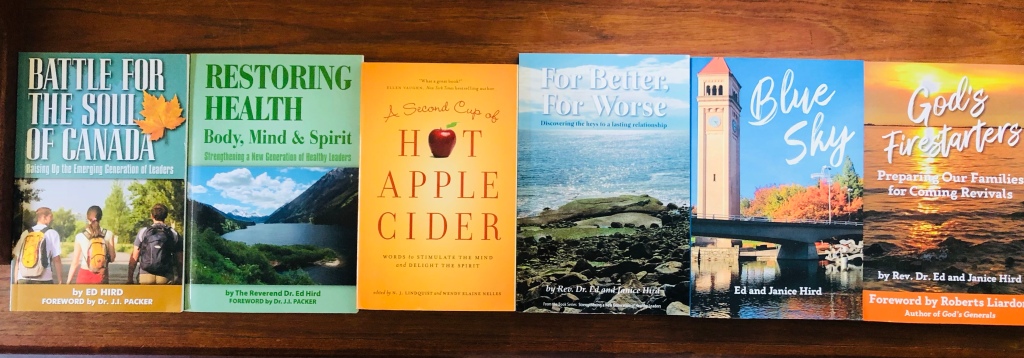
To purchase any of our six books in paperback or ebook on Amazon, just click on this link.


2 Comments

The Prayer Book: Yesterday, Today and Tomorrow

Three addresses were given at St. Paul’s Church, Bloor Street, Toronto, on May 1, 1999 at a special event organized by
the Prayer Book Society of Canada, Toronto Branch, in celebration of the 450th anniversary of the Book of Common Prayer

by

The (late) Revd. Dr. Robert Crouse, retired Professor of Classics at King’s College, Halifax;

The (late) Revd. Dr. James Packer, Professor of Systematic Theology at Regent College, Vancouver

The Revd. Dr. Ed Hird, rector of St. Simon’s Church North Vancouver (1987-2018)

“FILLED WITH THE KNOWLEDGE OF HIS WILL”  (Col. 1:1-14)

    The Revd. Dr. Ed Hird, BSW, MDiv, DMin

The Revd. Ed Hird was ordained in 1980.  He served in the parishes of St. Philip’s, Vancouver, and St. Matthew’s, Abbotsford, before becoming the rector of St. Simon’s Church in North Vancouver in 1987.   Ed is the past National Chair of Anglican Renewal Ministries Canada, and has spoken at Renewal, Essentials and Prayer Book Society conferences in Honduras and in various locations across Canada.  Inspired by the Essentials movement, he re-introduced the Prayer Book as one of the two main Sunday services in his congregation.

   We live in an age in which the knowledge of God’s will is deemed by many to be either unknowable or irrelevant.  Our society reminds me of the story of the roving TV reporter who was sent out to the shopping malls on Saturday morning to investigate the problem of teenage apathy and ignorance.  Every teenager had the same response: “I don’t know and I don’t care”!   And to be fair, teenagers are not the only Canadians suffering from spiritual ignorance and apathy.  I remember an adult coming up to me after a sermon I preached in a previous parish.  This person said, “I’m totally shocked.  I have never made it before to the end of a sermon.  I would always just doze off and wake up at the end of the message.  But this time I actually heard it through to the end.”

This problem of apathy and ignorance can be traced back to the ancient disease of Pyrrhonism.  Pyrrhonism is a system of skeptical philosophy, expounded in 300 BC by the Greek thinker, Pyrrho of Elis.1  The heart of Pyrrhonism is the denial of all possibility of attaining certainty in knowledge.  All one is left with is the classic west-coast phrase: “Well, whatever works for you”.   With the collapse of confidence in objective truth, our Canadian culture is sinking in intellectual subjectivism and moral anarchy.  We have seen a Canadian judge strike down child pornography laws while claiming that our Canadian Constitution and our Charter of Rights somehow protect the possession of child pornography.  We live in an age where there “is no king and everyone does as they see fit.” (Judg. 21:25).  We live in an age of leadership crisis.  It is not just our politicians, our police officers, our school teachers, our military leaders.  Even in the Church, yes, in the Anglican Church, there is a profound leadership crisis that is crippling our corporate ability to get on with the task of making disciples of all nations.  Perhaps the never-ending “sexual politics” in the Anglican Church of Canada is really a symptom of a deeper leadership crisis.

More than ever, we need to discover afresh what it means to be filled with the knowledge of God’s will and given the power to carry out that will.  As J. John at the Canterbury ‘98 Conference put it, “We only have enough time to do the will of God”.  So many of us in the Church are like Martha whom Jesus said was distracted by many things, but missing the main one of sitting at Jesus’ feet.

One of the many things I appreciate about the Prayer Book Society is the clarion call to prayer.  The Prayer Book Society is not a Colonel Blimp English Memorial Society.2  Rather it constitutes a mobilization of God’s troops to the sacred calling of spiritual warfare through sustained and intensive prayer.  If there is anything that we know about God’s will, it is that God wills that we “pray without ceasing”.  Let’s be honest.  How many of us need to cut back on our prayer life, because it is getting in the way of doing God’s will?  Despite any fears that prayer will make us so heavenly-minded that we are no earthly good, the truth of the matter is that only the prayerful and heavenly-minded are ultimately any earthly good.  The late Mother Teresa of Calcutta was a living testimony to the intimate relationship between prayer and resulting action.

It is not without reason that the Apostle Paul calls us again and again to “devote ourselves to prayer, being watchful and thankful” (Col. 4:2).  Prayer is the backbone of all lasting renewal.  As Dr. E. Stanley Jones, the famous Methodist missionary to India put it, “there can be no great spiritual awakening either in the individual or in the group unless and until the individual or the group give themselves to prayer.”3  Dr. Jones goes on to say: “When we feel that there is something wrong and that it is all ending in futility, instead of giving ourselves to prayer, we appoint a committee!  If a monument”, says Dr. Jones, “were erected over the dead situations in Christendom, we might inscribe on it ‘Committeed to Death’.  We call a committee instead of calling to prayer.”  It has been said that the 16th century Reformation began in Luther’s prayer closet.  The truth is that all reformation, all renewal, all restoration begins in someone’s prayer closet.  Quoting Dr. Jones again, “we find sooner or later that in prayer we either abandon ourselves or we abandon prayer.  Prayer will keep us from self-withholding or self-withholding will keep us from prayer.”4

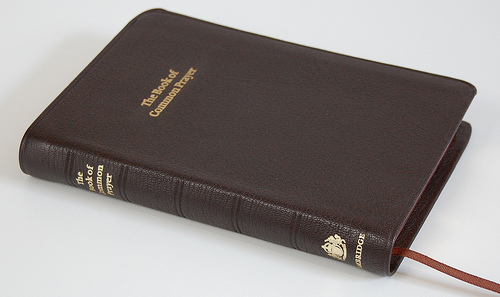
I would encourage you, if you have your Bibles with you, to turn in the book of Colossians to Chapter One, which deals with one of the greatest prayers in the New Testament.  I believe that it would be presumptuous to try to improve on the New Testament prayers.  Rather, our goal as 21st Century Anglicans should be to model all of our prayers on the biblical pattern of prayer shown especially by Jesus and the Apostle Paul.  I remember my rector, Ernie Eldridge,  telling me that one of the great strengths of the Book of Common Prayer is that something like 80% of it is straight from the Bible.  The prayers in the BCP were written by people who were steeped in the biblical thought forms, and so produced biblically sound and lasting prayers.

Paul is writing here to a formerly great and flourishing city that had been in a recession for the last three to four hundred years.  Colossae, whose name means “Monstrosity”, had become a backwater no-name town that had been left behind in the busy pace of 1st century Greek life.  Its neighbouring towns, Laodicea and Hierapolis were well-known respectively for their financial and administrative prowess, and for their burgeoning tourist and hot springs industry.  They, like Colossae, were located on the River Lycus, a river famous for overlaying its surrounding river banks with thick deposits of chalk.  As Bishop J.B. Lightfoot put it, “Ancient monuments are buried; fertile land is overlaid; river beds choked up and streams diverted; fantastic grottoes and cascades and archways of stone are formed, by this strange, capricious power, at once destructive and creative, working silently throughout the ages.  Fatal to vegetation, these incrustations spread like a stony shroud over the ground.  Gleaming like glaciers on the hillside, they attract the eye of the traveller at a distance of twenty miles, and form a singularly striking feature in scenery of more than common beauty and impressiveness.”5  In some ways, Bishop Lightfoot’s description seems like a parable of the Canadian Church … beautiful, impressive, but calcified and choked up by double-mindedness and fear.

Paul had never personally visited Colossae.  Rather, he preached extensively in the coastal city of Ephesus, with the result that his new converts spread the gospel extensively to many lesser-known cities and towns that were further inland.  There is a remarkable similarity between the books of Ephesians and Colossians, especially in the structure of Paul’s prayers in both epistles.  In both Colossians and Ephesians, Paul centres his prayer in thanksgiving.  You will notice in verse 3 how Paul says: “We always thank God the Father of our Lord Jesus Christ, when we pray for you …”.  In a structure similar to that of the Lord’s Prayer, Paul pays the debt of gratitude before he moves into his personal requests.  “Thy kingdom come” needs to come before “Give us this day our daily bread.”  In the Alpha Course, Nicky Gumbel says that the three key prayers that we can pray are “thank you”, “please”, and “sorry”.   Back in 1931, Bishop Lewis Radford of Goulbourn, Australia commented regarding this passage that “a survey of the grounds for thanksgiving revives the spirit of hope, and provides fresh material for petition.”6  The Christian life is not a life of Pollyanna-style positive thinking, but rather that of eucharistic thanksgiving in all circumstances, trusting that God can turn everything that is against us to our advantage, that all things work to the good for those who love him.

Why was Paul so thankful?  Verses 4 and 5 tells us that Paul was thankful because of the great triad of Christian graces: faith, hope, and love.  So often when Paul prays, he prays according to the three-fold pattern of the only things that will remain in the end.  Faith: their faith in Christ Jesus; Hope: hope stored up for us in heaven; and Love: love for all the saints.  As Bishop J.B. Lightfoot put it, “faith rests on the past; love works in the present; hope looks to the future”.7  Does the Prayer Book Society, indeed does the Anglican Church have a future as we celebrate the 450th Anniversary of the Book of Common Prayer?   I believe that the answer to both questions is yes, if we will ground our Christian life more and more on the three-fold graces of faith, hope and love.

I will always remember Dr. Robert Crouse’s presentation at the Montreal Essentials ‘94 Conference when he spoke of “despair, that most dangerous of all sins.”8  Satan, the ultimate deceiver and seducer of God’s people, is a past master at the use of discouragement and despair in crippling the saints.  He would love us to believe that Anglicanism is beyond hope, that there is no point in praying and working for the restoration of biblical orthodoxy.   We can thank our Lord Jesus Christ that he will always have a faithful Anglican witness in Canada, even if someday it may require missionaries from Africa and Asia to come and re-establish the gospel in our own homeland.

The good news found in verse 6 of Chapter 1 of Colossians is that “all over the world the gospel is producing fruit and growing”.  Lambeth ‘98 was a powerful reminder of that truth with the hundreds of Asian, African, and South American bishops making their presence felt in unforgettable ways.  The gospel, as Bishop Lewis Radford put it, is both a transforming force and a travelling fire.9  It is a fire that cannot be stamped out no matter how hard secularists and revisionists may try.  Verse 7 tells us about Epaphras, the founder of the Church at Colossae.  Some early church traditions make him the first bishop of Colossae.10  Verse 7 describes him as “our dearly loved fellow servant”, as a faithful minister of Christ on our behalf.  Both Paul and Epaphras were passionate that the Colossians should be filled with the knowledge of God’s will.  Epaphras was so passionate about this that Paul commented in Colossians chapter 4, verse 2 that Epaphras was “always wrestling in prayer for you that you may stand firm in all the will of God, mature and fully assured.”  The Greek word for wrestling is agonizomenos which means to agonize.  It is God’s will that each of us agonize in prayer for the restoration of faithful Anglicanism in Canada.  Wrestling in prayer is the key to being filled with the knowledge of God’s will.

That is why the Rev. Samuel Shoemaker, the Anglican priest who wrote the “12 Steps” and helped to found Alcoholics Anonymous, quoted Colossians Chapter 1 in writing step 11.  What does Step 11 encourage us to pray for: “… the knowledge of His will for us and power to carry that out.”

What is the use of knowing what to do, if we haven’t the power to do it?  What is the use of studying the Bible if we never do the Bible?  What is the use of praying the Prayer Book if we never live out the Prayer Book?  The key to doing the Bible and living the Prayer Book is Colossians chapter 1, verse 8: “love in the Spirit”.  It is not the love of power that will set the Anglican Church free, but rather the power of love.  Dr. Gordon Fee, the well known New Testament Scholar from Regent College, notes that virtually everywhere that the word “power” is used in the New Testament, it is referring to the power of the Holy Spirit.11  Only the Holy Spirit can give us the power to change.  Only the Holy Spirit can give us the power to love.  Only the Holy Spirit can give us the power to forgive.  Verse 8 tells us the secret of lasting renewal: “love in the Spirit”.

In the early days of Anglican renewal, a bishop in northern B.C. fired his dean because some of his parishioners had had the nerve to pray that the bishop be filled with the Holy Spirit.  If only they had just prayed for the bishop to be filled afresh or anew, the Dean might have kept his job.  Why do all of us need to be filled with the Spirit again and again? (Eph. 5:18).  The reason, as D.L. Moody put it, is that we leak.  It is always touchy to pray for one’s bishop without sounding like one is trying to give his bishop advice.  It is so easy for us to dump all our unmet dreams and frustrations on the back of our bishops.  Yet God calls us to bless and not curse.  God calls us in verse 9 to never give up praying for each other, and that certainly includes our bishops.  Verse 9 is a wonderful way to pray for your bishop, your rector, and your wardens in a way that none of them could possibly object to.  Just pray that God will fill them with the knowledge of His will through all spiritual wisdom and understanding.  All of us need to be filled up, to be more full of God’s grace, peace, joy, hope, and faith so that we will be more full, more grace-full, more peace-full, more joy-full, more faith-full.  The point of the fruit of the Spirit (Gal. 5:22) is to fill us up inside with more of the character of Jesus Christ.

What will being filled with the knowledge of God’s will really do for us?  Paul tells us in verse 10 that such filling will result in our walking worthy of God, in our pleasing the Lord in every way, in our bearing fruit in every good work, in our growing in the knowledge of God.  Being filled with the knowledge of His will is the key not only to living in the Spirit but also to walking in the Spirit (Gal. 5:25).  As our AA friends remind us, it is not enough to talk the talk; we also need to walk the walk.

Yet all of us are powerless in ourselves to change our lives.  In fact, no change is possible until we admit in the words of Step 1 that “We are powerless over our (addictions and sins) and our lives have become unmanageable”.  The reason why “12 Step” people talk so much about a Higher Power is that our own power, our own resources, are never enough to make a lasting difference.  We need, in the words of Luke 24:49, to be clothed with power from on high, the very power of the Holy Spirit.  That is why Acts 1:8 says that “You shall receive power when the Holy Spirit comes upon you and you shall be my witnesses … to the ends of the earth.”.  That is why Colossians chapter 1 verse 11 talks about our being strengthened with all power: in the Greek, “being powered with all power”, with all dunamis, all dynamite.  There are logjams in Anglicanism that nothing but the power, the dynamite, of the Holy Spirit can possibly remove.  All of us know many faithful Anglicans who have given up in despair and left our church, perhaps returning occasionally for their Communion “fixes”.  When we think of the mother/father God/Goddess apostasy that the new ACC “Common Praise” hymn book is leading us into, only the power of the Holy Spirit will be able to lead us out of that syncretistic swamp.  Yet with God, nothing is impossible!  Would anyone like to become the founders of a Blue Hymn Book Society of Canada?

Dr. E. Stanley Jones holds that “the difference between a river and a swamp is that one has banks and the other has none.  The swamp is very gracious and kindly, it spreads over everything, hence it is a swamp.  Some of us are moral and spiritual swamps.  We are so broad and liberal that we take in everything from the shady to the sacred.  Hence we are swamps.  A river has banks – it confines itself to its central purpose.  The civilizations of the world organize themselves not around swamps, but around rivers.”12

To me, the Book of Common Prayer and the Bible are rivers.  The new Common Praise hymn book in contrast is a gracious and kindly swamp.  The river that is the Holy Spirit confines Himself to His central purpose, which is to fill us with the knowledge of the Father’s will and to give us the power to carry that out.  The Colossian Christians were a tiny, faithful minority living in a “new-age” spiritual scene.  As with the original Colossian church, one of the greatest challenges facing our Anglican Church is well-meaning interfaith syncretism.  In our worship of newness and inclusiveness, we are rushing to replace the riverbanks of our BCP with the neo-gnostic swamp of centering prayer/mantra yoga, enneagram workshops, labyrinths, Jungian-based MBTI personality tests, and invocations of “God our Father and our Mother”.13  Lord, forgive us for our naïve worship of the seemingly new and trendy, and for our disrespect for the wisdom of our Anglican forebears.  Genuine renewal is actually about renewing the riches of our inheritance in Christ Jesus, not about uncovering secret “new revelations”. (Eph. 1:18)

Most renewal movements in the past few centuries, including the various holiness, pentecostal, charismatic, and third-wave expressions, can be traced back to the influence of two Anglican priests, John and Charles Wesley, the founders of Methodism.  Canadian Methodism was the largest of the bodies which came together to form the United Church of Canada in 1925.  Few people realize what a high view the Wesleys had of the Anglican prayer book and of the Anglican Church in general.  Even on the verge of being forced to ordain his own preachers, John Wesley commended the Church of England to his leaders as “the best constituted national church in the world”.14  John Wesley also taught his followers that “there is no LITURGY in the World, either in ancient or modern language, which breathes more of a solid, scriptural, rational Piety, than the COMMON PRAYER of the CHURCH of ENGLAND”.15  John Wesley did not just appreciate the Prayer Book theology.  He even loved its language, language which he described as “not only pure, but strong and elegant in the highest degree.”16  John and Charles Wesley experienced manifestations of the Holy Spirit that would make the Toronto Airport Fellowship look tame, yet the Wesleys still held up the Prayer Book as a vital tool for orthodoxy and renewal.  And John Wesley was even radical enough that he advised all his clergy to administer the Lord’s Supper every Sunday at the main service.17

As Dr. Bard Thompson put it, “It was the way of John Wesley to espouse extempore prayer, yet esteem the prayer book; to give free expression to evangelical power, yet prize the structures of the church …”18  Yet sadly Wesley’s wisdom was largely ignored.  His followers decided that they could pray better and with more devotion when their eyes were shut, than they could with their eyes open, praying from a book.19  So they cast aside the Prayer Book and produced the United Church of Canada instead.  Wesley drew the balance between the stability of tradition and the dynamism of the Spirit.  His followers, however, became progressively less rooted generation after generation.  It is so easy to cast aside “the riches of our inheritance”.  It is much harder to humble ourselves enough to go back home and start afresh.  I remember how hard I tried to convince my Grandma Allen to “get with it” and give up on the Book of Common Prayer.  But she was so “stubborn and inflexible” that she died with the Bible and the Prayer Book by her bedside.

Our parish of St. Simon’s had not used the Book of Common Prayer at its main service for over 25 years.  When I came back from the Montreal ‘94 Essentials Conference and suggested that we might try doing the Prayer Book on fifth Sundays, some of my leadership secretly wondered if I might have lost my mind.  But eventually they came to see in unity what I was talking about.

Reintroducing the Prayer Book as one of our two main services has brought 30% growth in average Sunday attendance over the next two years.  I am not saying that it was easy to reintroduce the Book of Common Prayer.  Many Anglicans don’t like change, even if it means restoring the riches of their inheritance.  There are many well-meaning Anglican clergy out there who would rather die than admit they may have made a mistake in abandoning the classic Book of Common Prayer.  Many clergy have battle scars from liturgy wars in the 1970’s and early 80’s.  They have finally achieved relative liturgical calm in their parishes and they are reluctant to “open up old wounds”, and disturb the relative truce.

But God’s will for us as clergy is not merely for us to preserve the peace or to be keepers of ecclesiastical aquariums, but rather to be fishers of men and women.  Our greatest desire as Anglican leaders must be our desire to be filled with the knowledge of God’s will and to have the power of the Holy Spirit to carry it out.  Why else do we pray every day “Thy kingdom come, Thy will be done”.  What is God’s will?  The Bible is clear that God’s will, among other things, is that we go into all the world, preaching the gospel to all creation, and that we make disciples of all nations (Mark 16:15, Matthew 28:19).  1 Timothy chapter 2, verses 4 and 5 tells us clearly that God’s will is that all people be saved and come to a knowledge of the truth, and that there is only one mediator, one bridge between God and humanity, the man Christ Jesus, who gave himself as a ransom for all.

The leadership crisis in Anglicanism is directly linked to a growing fuzziness of vision regarding God’s will that the lost be found.  Many church leaders are beginning to publicly question whether the lost are really lost after all, and whether God really wants to find them.  Unless we are convinced that the man Christ Jesus is the only mediator between God and humanity, and that he really gave himself as a ransom for all, not just for those raised in the church or in the west, we will not have the power to carry out this great and lasting commission.  As Dr. John Stott put it at an Vancouver Anglican Essentials gathering, we claim uniqueness and finality in Christ alone.

If all we do is squabble about liturgical preferences and do not reach the lost, we are a people most to be pitied.  The Book of Common Prayer is not an ingrown book.  It is a book with a passion that the lost might be found.  In contrast to the BAS, the BCP is clear that God wants us to win the world for Christ.  The BAS, if you read it carefully, is written in a way that it can either encourage you to do evangelistic mission work for Christ or merely to affirm God in all cultures.  The BCP, however, is uncompromising in its biblical stance that “God is not willing that any should perish but that all may come to repentance.” (2 Peter 3:9)  As the former Archbishop of Canterbury, George Carey, said at Kanuga, “Evangelism is not a matter to be debated but a command to be obeyed.”  God’s will, as expressed in Colossians 1 verse 13, is that he might rescue (many) from the dominion of darkness and bring (them) into the kingdom of his beloved Son, in whom we might have redemption, the forgiveness of sins.  We say each Sunday in the Creed that we believe in the forgiveness of sins.  Are you sharing that forgiveness with your lost neighbour, family member, co-worker?

I pray in conclusion that God may fill each of us with the knowledge of His will, that none should perish, that all may come to repentance, and that God may give us the power of the Holy Spirit to carry out his will to the very ends of the earth, in Jesus’ name.  Amen.

The Rev. Dr. Ed Hird, BSW, MDiv, DMin

Past Chair, Anglican Renewal Ministries of Canada

-award-winning author of the book Battle for the Soul of Canada

 Endnotes:

  1. The Oxford Dictionary of the Church, F.L. Cross, ed. (Oxford University Press, 1957), p. 1128.
  2. Colonel Blimp was a humorous anachronistic figure in the British WW2-based television series “Dad’s Army”.
  3. Dr. E. Stanley Jones, Pentecost: the Christ of Every Road, (Nashville: Abingdon Press, 1930), p. 247.
  4. Ibid., p. 248.
  5. The Rt. Revd. Dr. J.B. Lightfoot, as quoted in Dr. William Barclay’s The Daily Study Bible: the Letters to the Philippians, Colossians, and Thessalonians (Toronto: G.R. Welch Co. Ltd.), p. 91.
  6. The Rt. Revd. Dr. Lewis B. Radford, Colossians (London: Methuen & Co. Ltd, 1931), p. 3.
  7. Ibid., p. 151.
  8. Anglican Essentials, George Egerton, ed. (Toronto: Anglican Book Centre, 1995), p. 289.
  9. Radford, op. cit., p. 153.
  10. Ibid., p. 154.
  11. Dr. Gordon Fee, God’s Empowering Presence (Massachusetts: Hendrickson Publishers, 1994), p. 35.
  12. Dr E. Stanley Jones, op. cit., p. 227.
  13. As done in the Canadian Anglican “Common Praise” hymn book (1999), which tragically alters the much-loved “Joyful, Joyful, We Adore Thee” hymn from “God our Father, Christ our Brother” to “God our Father and our Mother”.
  14. Liturgies of the Western Church, “The Sunday Service”, ed. Bard Thompson, (Cleveland and New York, Meridan Books, The World Publishing Company, 1961), p. 416.
  15. Ibid., p. 416.
  16. Ibid., p. 416.
  17. Ibid., p. 416.
  18. Ibid., p. 416.
  19. Ibid., p. 410.

This booklet is published by the Toronto Branch of the Prayer Book Society of Canada.  Additional copies can be ordered at a cost of $2 each from Dr. Diana Verseghy, 16 Capilano Court, Concord, Ontario, L4K 1L2.
E-mail: Diana.Verseghy@ec.gc.ca

“I’m afraid there’s been an accident…”

12bdf6ff-3021-4e73-bccd-bc919398d1a0-7068-0000031133e7b4d9Sandy Brown and her family have just moved to Spokane, Washington where her husband, Scott, is pastoring a new church. With a fresh start, Sandy is determined to devote more time to her four children. But, within weeks of settling in their new life, the Brown family is plunged into turmoil.

Sandy receives shocking news that her children aren’t safe, which brings back haunting memories of the trauma she experienced as a girl. Then, the unthinkable happens…

A brutal attack puts Sandy on the brink of losing everything she’s loved. Her faith in God and the family she cherishes are pushed to the ultimate limit.

Is healing possible when so many loved ones are hurt? Are miracles really possible through the power of prayer? Can life return to the way it was before?

Blue Sky reveals how a mother’s most basic instinct isn’t for survival… but for family.

If you’re a fan of Karen Kingsbury, then you’ll love Blue Sky. Get your copy today on paperback or  kindle.

-Click to check out our marriage book For Better For Worse: discovering the keys to a lasting relationship on Amazon. You can even read the first two chapters for free to see if the book speaks to you. 

-The sequel book Restoring Health: body, mind and spirit is available online with Amazon.com in both paperback and ebook form.  Dr. JI Packer wrote the foreword, saying “I heartily commend what he has written.” The book focuses on strengthening a new generation of healthy leaders. Drawing on examples from Titus’ healthy leadership in the pirate island of Crete, it shows how we can embrace a holistically healthy life.

In Canada, Amazon.ca has the book available in paperback and ebook. It is also posted on Amazon UK (paperback and ebook), Amazon France (paperback and ebook), and Amazon Germany (paperback and ebook).

Restoring Health is also available online on Barnes and Noble in both paperback and Nook/ebook form.  Nook gives a sample of the book to read online.

Indigo also offers the paperback and the Kobo ebook version.  You can also obtain it through ITunes as an IBook.

To receive a signed copy within North America, just etransfer at ed_hird@telus.net, giving your address. Cheques are also acceptable.

-Click to purchase the Companion Bible Study by Jan Cox (for the Battle of the Soul of Canada) in both paperback and Kindle on Amazon.com and Amazon.ca 

Indigo also offers the paperback and the Kobo ebook version.  You can also obtain it through ITunes as an IBook.

-Click to purchase the Companion Bible Study by Jan Cox (for the Battle of the Soul of Canada) in both paperback and Kindle on Amazon.com and Amazon.ca 

To purchase any of our six books in paperback or ebook on Amazon, just click on this link.


2 Comments

Tilley and Tupper Our Founding Fathers

By the Rev. Dr. Ed Hird
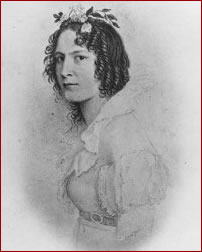
Sir Samuel Leonard Tilley, a Father of Canadian Confederation and twice the Lt. Governor of New Brunswick, rose each morning to start his day with prayer and Scripture reading.  As the 33 founding Fathers gathered in 1864 at Charlottetown, PEI, there were many suggestions on what to call this new nation. That morning, as Tilley read from Psalm 72:8, he became so convinced that Canada should be a nation under God, that when he came down to the Conference session, he presented the inspired name “Dominion of Canada”.  Our National Motto on our Coat of Arms “A Mari Usque Ad Mare” (from sea to sea) was drawn once again straight from Psalm 72:8. “He shall have dominion from sea to sea.”

Tilley came to a personal knowledge of Jesus Christ in 1839 through his Anglican rector, the Reverend William Harrison. His life was so dramatically transformed that he even became an Anglican Sunday School teacher and a Church Warden (Elder).  Tilley’s son Harrison became a well-known Anglican priest.

One day, an 11-year old girl ran to Tilley for help, after her drunken father brutally stabbed her mother to death.  Because of this tragedy, Tilley went from being a quiet pharmacist to becoming the Premier of New Brunswick in his campaign for alcohol reform. When Tilley brought in actual alcohol legislation, he was burned in effigy, his house was attacked, and his family’s lives were threatened.

 Tilley the ‘dry’ Anglican was good friends with Sir Charles Tupper the ‘drinking’ Baptist Premier of Nova Scotia.  Both shared a passion for railways which they believed were the key to the Maritimes’ future.  Sir Charles Tupper eventually became the Federal Minister of Railways, bringing the CPR railway line to Vancouver, and BC into Confederation. Before the arrival of the railway, traveling to Vancouver would take all summer by riverboat and stagecoach.

The 1864 Charlottetown meeting was originally intended to bring a Maritime Union of New Brunswick and Nova Scotia, to defend against the threat of American invasion. But Tupper and Tilley dreamed bigger, inviting Ontario and Quebec to join them in a new Confederation. Tupper believed in the greatness of Canada, saying: “The human mind naturally adapts itself to the position it occupies. The most gigantic intellect may be dwarfed by being cabin’d, cribbed and confined. It requires a great country and great circumstances to develop great men.”

Tupper read the Bible fully from cover to cover by the age of eight. His father Charles Tupper Senior, a prohibitionist, was one of the founding fathers of the fast-growing Maritime Baptist Churches. While training as a medical doctor in Edinburgh, Charles Jr discovered Scotch from which he never recovered.  Tupper served as first president of the Canadian Medical Association.

In 1867 the Halifax Morning Chronicle had described Tupper as “the most despicable politician within the bounds of British North America.”  Throughout his career Tupper was variously described as “the Boodle Knight,” the “Great Stretcher” (of the truth), “the old tramp,” the “Arch-Corruptionist,” and “the old wretch.”.

Tupper has the distinction of being the shortest-serving Prime Minister in Canadian history, even beating out Joe Clark and Kim Campbell (67 days!). His marriage, despite allegations of philandering, lasted longer than any other Prime Minister: 66 years!

Tupper, the longest-surviving Father of Confederation, served in six federal cabinet portfolios. If there was something that was really difficult to get done, somebody who needed to be won over, Macdonald often said: ‘Call Tupper.’ Tupper could make things happen.

Sir Charles Tupper and Sir Leonard Tilley remind us that God can use the most unlikely people in building a nation.

The Rev. Dr. Ed Hird, BSW, MDiv, DMin

-previously published in the Light Magazine and the North Shore News

-award-winning author of the book Battle for the Soul of Canada

“I’m afraid there’s been an accident…”

12bdf6ff-3021-4e73-bccd-bc919398d1a0-7068-0000031133e7b4d9Sandy Brown and her family have just moved to Spokane, Washington where her husband, Scott, is pastoring a new church. With a fresh start, Sandy is determined to devote more time to her four children. But, within weeks of settling in their new life, the Brown family is plunged into turmoil.

Sandy receives shocking news that her children aren’t safe, which brings back haunting memories of the trauma she experienced as a girl. Then, the unthinkable happens…

A brutal attack puts Sandy on the brink of losing everything she’s loved. Her faith in God and the family she cherishes are pushed to the ultimate limit.

Is healing possible when so many loved ones are hurt? Are miracles really possible through the power of prayer? Can life return to the way it was before?

Blue Sky reveals how a mother’s most basic instinct isn’t for survival… but for family.

If you’re a fan of Karen Kingsbury, then you’ll love Blue Sky. Get your copy today on paperback or  kindle.

-Click to check out our marriage book For Better For Worse: discovering the keys to a lasting relationship on Amazon. You can even read the first two chapters for free to see if the book speaks to you.

-The sequel book Restoring Health: body, mind and spirit is available online with Amazon.com in both paperback and ebook form.  Dr. JI Packer wrote the foreword, saying “I heartily commend what he has written.” The book focuses on strengthening a new generation of healthy leaders. Drawing on examples from Titus’ healthy leadership in the pirate island of Crete, it shows how we can embrace a holistically healthy life.

In Canada, Amazon.ca has the book available in paperback and ebook. It is also posted on Amazon UK (paperback and ebook), Amazon France (paperback and ebook), and Amazon Germany (paperback and ebook).

Restoring Health is also available online on Barnes and Noble in both paperback and Nook/ebook form.  Nook gives a sample of the book to read online.

Indigo also offers the paperback and the Kobo ebook version.  You can also obtain it through ITunes as an IBook.

To receive a signed copy within North America, just etransfer at ed_hird@telus.net, giving your address. Cheques are also acceptable.

-Click to purchase the Companion Bible Study by Jan Cox (for the Battle of the Soul of Canada) in both paperback and Kindle on Amazon.com and Amazon.ca 

Indigo also offers the paperback and the Kobo ebook version.  You can also obtain it through ITunes as an IBook.

-Click to purchase the Companion Bible Study by Jan Cox (for the Battle of the Soul of Canada) in both paperback and Kindle on Amazon.com and Amazon.ca

To purchase any of our six books in paperback or ebook on Amazon, just click on this link.


Leave a comment

Remembering Dear Nana

By the Rev. Dr. Ed Hird

Nana Allen, my maternal grandmother, died with her prayer book and bible by her bed. I was never successful in talking her out of using the “old-fashioned” Book of Common Prayer, and ‘getting with the program’.  Nana to me symbolizes the deep Judeo-Christian roots of our beloved Canadian nation.  She knew in her heart that I would one day become an Anglican priest, even when I was running from God on the top of Mount Seymour ski hill.  Nana, while outwardly a very gentle and proper ‘English’ lady, was inwardly a prayer warrior who never gave up on her family or her nation.  Nana’s passionate love for our nation came out most strongly when she watched Hockey Night in Canada, fervently cheering for her favorite team ‘The Montreal Canadiens’.

I love Nana very deeply, though she passed away in March 1982, just before my throat operation where I received my voice back.  It was hard for Nana to watch me lose my voice, as she was so deeply committed to my calling to the Anglican priesthood.  I remember her saying that she wanted to live until I became ordained as a deacon. Then after my first ordination, she decided that she wanted to live until I became priested which she did as well. Within a year of my priesting, she had gone to be with the Lord.

Why am I an Anglican priest today?  I believe in my heart of hearts that I am a priest because of my Nana’s powerful prayers and personal witness to a biblically faithful Anglicanism.  Nana’s life embodied to me the heart and soul of genuine Anglican Christianity.  Sadly most of the faithful congregations that my Nana attended have since been swallowed by other agendas.

Nana was also a devout Anglophile and royalist.  Though she had never been to England, it very much functioned for her as ‘the mother country’.  Nana was probably more English than the English.  My parents finally persuaded her at age 80 to fly to England with them.  While she enjoyed the trip tremendously, she felt that England had changed!

As someone who has been an ordained Anglican clergyman for 40 years, I must say similarly to my grandma’s comment that the Anglican Church has changed.  I value healthy, necessary change, but I grieve when the core values of the Anglican Church are discarded in the relentless search for temporary relevance.  I have sadly had to face that we are now often dealing with another gospel, another religion, another faith than the biblical Anglican Christianity that my dear Nana stood for.

I believe that the Anglican Church is the ‘canary in the tunnel’ for our great nation of Canada.   Our Canadian passivity has made us vulnerable to serious cultural meltdown of everything that made Canada great.  My grandparents’ and parents’ generation put everything on the line to defend our great nation in World War I and World War II.  How can we do any less in the current battle for the soul of Canada?

We say in the pre-amble to our Constitution that we acknowledge the Supremacy of God.  It is time for us as Canadians to turn our words into actions.  Our founding forebearers were determined in the words of Psalm 72 that ‘he would have dominion for sea to shining sea’.  Our original name “The Dominion of Canada” was chosen to deliberately reflect that spiritual commitment as the core of our nation.

My cry is that God would keep our land glorious and free, that God would have mercy upon our rebellious land, that mercy would triumph over judgement.  God’s heart of love is that we would repent of our turning away from our godly Judeo-Christian heritage and turn back before it is too late.

When I remember my dearly beloved Nana, I am reminded that we have a great heritage as Canadians.  Let’s not squander it.

The Rev. Dr. Ed Hird, BSW, MDiv, DMin

-previously published in the North Shore News

-award-winning author of the book Battle for the Soul of Canada

P. S. Click this Amazon link to view for free the first two chapters of our new novel Blue Sky.

“I’m afraid there’s been an accident…”

12bdf6ff-3021-4e73-bccd-bc919398d1a0-7068-0000031133e7b4d9Sandy Brown and her family have just moved to Spokane, Washington where her husband, Scott, is pastoring a new church. With a fresh start, Sandy is determined to devote more time to her four children. But, within weeks of settling in their new life, the Brown family is plunged into turmoil.

Sandy receives shocking news that her children aren’t safe, which brings back haunting memories of the trauma she experienced as a girl. Then, the unthinkable happens…

A brutal attack puts Sandy on the brink of losing everything she’s loved. Her faith in God and the family she cherishes are pushed to the ultimate limit.

Is healing possible when so many loved ones are hurt? Are miracles really possible through the power of prayer? Can life return to the way it was before?

Blue Sky reveals how a mother’s most basic instinct isn’t for survival… but for family.

If you’re a fan of Karen Kingsbury, then you’ll love Blue Sky. Get your copy today on paperback or  kindle.

-Click to check out our marriage book For Better For Worse: discovering the keys to a lasting relationship on Amazon. You can even read the first two chapters for free to see if the book speaks to you.

-The sequel book Restoring Health: body, mind and spirit is available online with Amazon.com in both paperback and ebook form.  Dr. JI Packer wrote the foreword, saying “I heartily commend what he has written.” The book focuses on strengthening a new generation of healthy leaders. Drawing on examples from Titus’ healthy leadership in the pirate island of Crete, it shows how we can embrace a holistically healthy life.

In Canada, Amazon.ca has the book available in paperback and ebook. It is also posted on Amazon UK (paperback and ebook), Amazon France (paperback and ebook), and Amazon Germany (paperback and ebook).

Restoring Health is also available online on Barnes and Noble in both paperback and Nook/ebook form.  Nook gives a sample of the book to read online.

Indigo also offers the paperback and the Kobo ebook version.  You can also obtain it through ITunes as an IBook.

To receive a signed copy within North America, just etransfer at ed_hird@telus.net, giving your address. Cheques are also acceptable.

-Click to purchase the Companion Bible Study by Jan Cox (for the Battle of the Soul of Canada) in both paperback and Kindle on Amazon.com and Amazon.ca 
Indigo also offers the paperback and the Kobo ebook version.  You can also obtain it through ITunes as an IBook.

-Click to purchase the Companion Bible Study by Jan Cox (for the Battle of the Soul of Canada) in both paperback and Kindle on Amazon.com and Amazon.ca


To purchase any of our six books in paperback or ebook on Amazon, just click on this link.


1 Comment

Chief Joseph Brant: Canadian Hero

By the Rev. Dr. Ed Hird

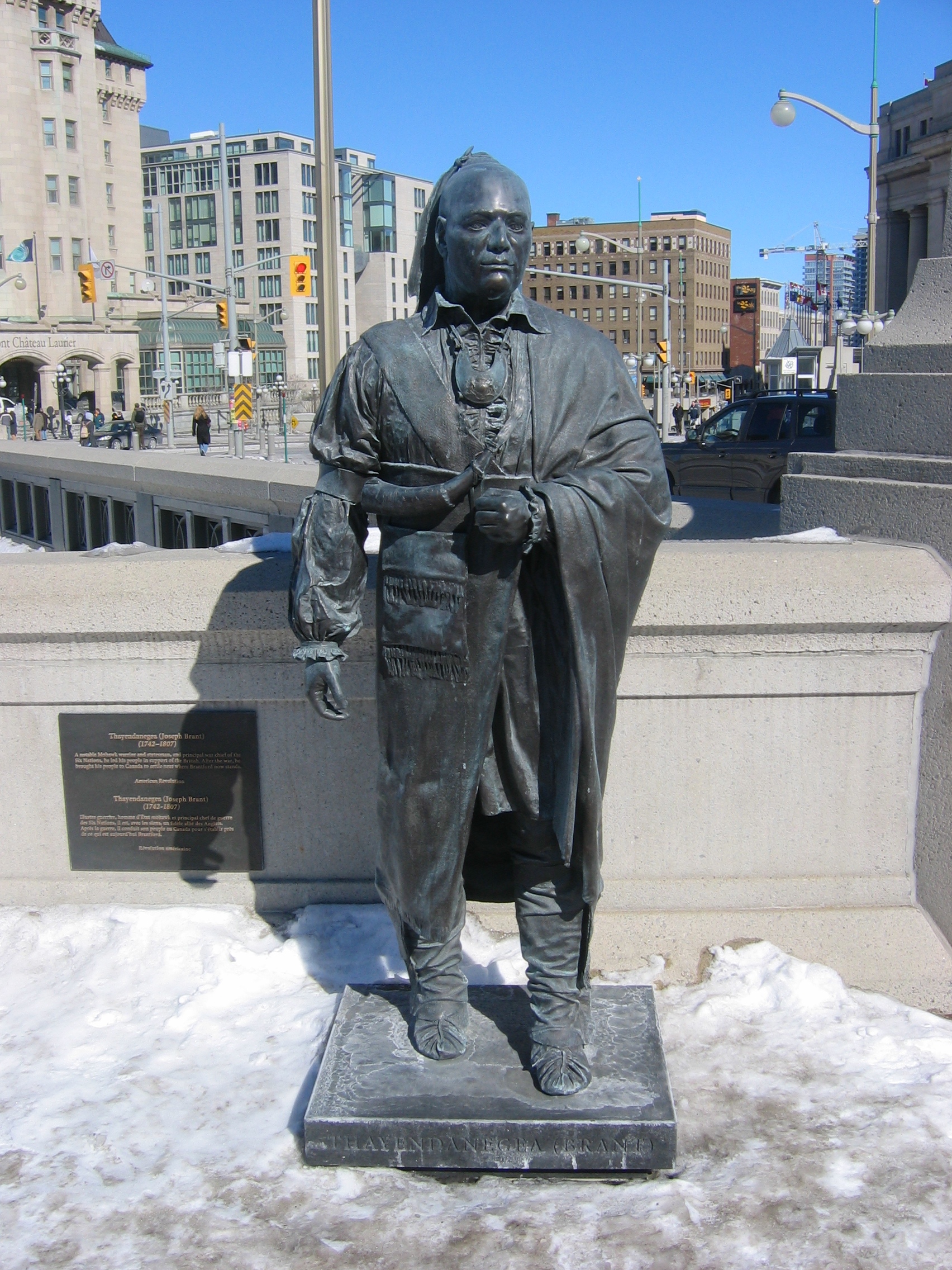
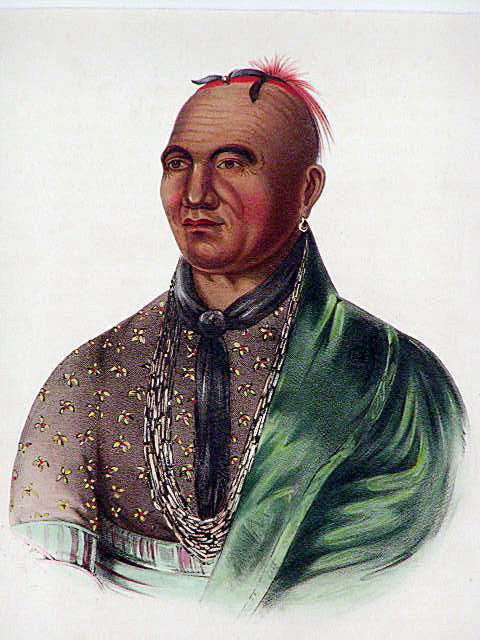
My wife and I had the privilege of attending the First Peoples Forgiven Summit in Ottawa.  During that time we were able to meet a number of Mohawk believers, including Jonathan Maracle of Broken Walls who led us in remarkable worship music.  Canada’s most famous Mohawk was Chief Joseph Brant.  Recently the Canadian Royal Mint produced a Canadian Loonie with the imprint of Chief Joseph Brant  (1742-1807).  More Canadians need to hear this story of this Canadian hero.  He was described by Mark Jodoin as having the mind of a statesman, the heart of a leader, and the soul of a warrior. Without the military and spiritual support of Chief Brant, Canada would have likely never survived.

Chief Joseph Brant’s Mohawk name was Thayendanegea which means “two sticks bound together for strength”.  Isabel Thompson Kelsay notes that “the most famous (aboriginal) who ever lived, has been for two centuries a virtual unknown.”   I suspect that he is unknown to most North Americans because he chose the side of Canada in the American revolutionary war.  As Canada’s premier First Nations leader, Brant had the privilege of meeting both Georges in person: King George III and President George Washington.

Brant learned to speak, read and write English at a New Hampshire school led by Rev Wheelock. Wheelock described Brant as being “of a sprightly genius, a manly and gentle deportment, and of a modest, courteous and benevolent temper.”  In 1772, Brant was then mentored by Rev John Stuart, being trained in the art of Bible and Prayer Book translation.  During that time, Brant developed a deep prayer life, becoming a committed Anglican Christian.

During the American Revolutionary war, Brant was falsely accused of committing atrocities in locations which he was not present, including the tragic Wyoming and Cherry Valley Massacres.  Those who knew Brant well testified that he often prevented atrocities through the use of his persuasive leadership. As a devout Anglican Christian, he exhibited compassion and humanity, especially towards women, children, and non-combatants. American Colonel Ichabod Alden commented that he “should much rather fall into the hands of Brant than either of them [Loyalists and Tories].”  It was frequently said of Joseph Brant that during the American revolution, he fought with a tomahawk in one hand, a copy of the New Testament in the other.

Joseph Brant’s father was one of the sachem/chiefs, known as the Four Indian Kings, who visited Queen Anne in 1710.  These chiefs asked ‘for missionaries to be sent to the People of the Longhouse to teach them more about Christianity.”  Queen Anne sent this request to the Anglican Archbishop of Canterbury, promising to build them a chapel. In 1711, Queen Anne’s Royal Chapel was built in the Mohawk Valley in New York State.  When the Mohawks relocated to Southern Ontario, the Mohawk Royal Chapel was rebuilt there in 1785.  Joseph Brant’s grave is located right next to the historic Mohawk Chapel, the oldest protestant church in Ontario. Just this past July, Queen Elizabeth, while visiting Ontario, presented the Mohawk Chapel with a set of eight silver hand bells engraved ‘The Silver Chain of Friendship 1710-2010’.

On each side of the Mohawk Chapel pulpit are two tablets in the Mohawk language of the Lord’s Prayer and the Ten Commandments.  Joseph Brant was a brilliant linguist translating the Bible and Anglican Prayer Book into Mohawk (of which there are microfiche copies at Simon Fraser University).  He also wrote a concise history of the Bible and a Mohawk language catechism. Brant spoke at least three and possibly all of the Six Nations’ languages.  When the Chapel was dedicated in 1788, each person was given a Mohawk book containing the Gospel of Mark and the Anglican Prayer Book.  At that celebration, sixty five Mohawks were baptized and three couples were married.

When Joseph Brant first visited England in 1775, he was described by a British commander as ‘His Majesty’s greatest North American subject.’, and painted in full aboriginal regalia by George Romney.  Receiving a captain’s commission, Brant met with the King on two occasions, with a dinner being held in his honour. Brant was honoured by the English leaders in the arts, letters and government, including James Boswell, the famed biographer of Samuel Johnson.

In 1779 Brant was commissioned by the King as ‘captain of the Northern Confederate Indians’ in recognition of his “astonishing activity and success’. Brant was described as “the perfect soldier, possessed of remarkable stamina, courage under fire, and dedicated to the cause, an able and inspiring leader and a complete gentleman.”

Joseph Brant’s Six Nations were tragically driven out of their homeland in Central New York.  Brant was hurt that in granting their Mohawk homeland in Central New York State to the Americans, England had ‘sold the Indians to the US Congress’.  Writing to King George III, he reminded the British that “we, the Mohawks, were the first Indian Nation that took you by hand and invited you to live among us, treating you with kindness…”  The Six Nations were eventually resettled by Governor Frederick Haldimand in the Grand River area around modern-day Brantford.  The British realized that locating the Six Nations in the Grand River area would be a natural protection against any future American invasion.  Initially the Mississauga First Nation resisted the concept of having their former foes on their land.  One Mississauga Chief Pokquan however persuaded his other chiefs by arguing that other aboriginals would be better neighbours than European settlers, and that Brant’s knowledge of the British could prove useful.

The term Brantford comes from Brant’s Ford, the shallow part of the Grand River that could be forded.  The first years at Brantford were difficult as there was a drought with game being hard to find.  Throughout all the challenges, Chief Brant’s deep faith sustained him.  Chief Brant’s sacrificial love for God and nation should inspire all of us.  He memorably said: “No person among us desires any other reward for performing a brave and worthwhile action but the consciousness of having served one’s nation.”

May all of us be willing to learn from the bravery and loyalty of Chief Joseph Brant.

The Rev. Dr. Ed Hird, BSW, MDiv, DMin

-previously published in the North Shore News/Deep Cove Crier

-award-winning author of the book Battle for the Soul of Canada

P. S. Click this Amazon link to view for free the first two chapters of our new novel Blue Sky.

“I’m afraid there’s been an accident…”

12bdf6ff-3021-4e73-bccd-bc919398d1a0-7068-0000031133e7b4d9Sandy Brown and her family have just moved to Spokane, Washington where her husband, Scott, is pastoring a new church. With a fresh start, Sandy is determined to devote more time to her four children. But, within weeks of settling in their new life, the Brown family is plunged into turmoil.

Sandy receives shocking news that her children aren’t safe, which brings back haunting memories of the trauma she experienced as a girl. Then, the unthinkable happens…

A brutal attack puts Sandy on the brink of losing everything she’s loved. Her faith in God and the family she cherishes are pushed to the ultimate limit.

Is healing possible when so many loved ones are hurt? Are miracles really possible through the power of prayer? Can life return to the way it was before?

Blue Sky reveals how a mother’s most basic instinct isn’t for survival… but for family.

If you’re a fan of Karen Kingsbury, then you’ll love Blue Sky. Get your copy today on paperback or  kindle.

-Click to check out our marriage book For Better For Worse: discovering the keys to a lasting relationship on Amazon. You can even read the first two chapters for free to see if the book speaks to you.

-The sequel book Restoring Health: body, mind and spirit is available online with Amazon.com in both paperback and ebook form.  Dr. JI Packer wrote the foreword, saying “I heartily commend what he has written.” The book focuses on strengthening a new generation of healthy leaders. Drawing on examples from Titus’ healthy leadership in the pirate island of Crete, it shows how we can embrace a holistically healthy life.

In Canada, Amazon.ca has the book available in paperback and ebook. It is also posted on Amazon UK (paperback and ebook), Amazon France (paperback and ebook), and Amazon Germany (paperback and ebook).

Restoring Health is also available online on Barnes and Noble in both paperback and Nook/ebook form.  Nook gives a sample of the book to read online.

Indigo also offers the paperback and the Kobo ebook version.  You can also obtain it through ITunes as an IBook.

To receive a signed copy within North America, just etransfer at ed_hird@telus.net, giving your address. Cheques are also acceptable.

-Click to purchase the Companion Bible Study by Jan Cox (for the Battle of the Soul of Canada) in both paperback and Kindle on Amazon.com and Amazon.ca 

Indigo also offers the paperback and the Kobo ebook version.  You can also obtain it through ITunes as an IBook.

-Click to purchase the Companion Bible Study by Jan Cox (for the Battle of the Soul of Canada) in both paperback and Kindle on Amazon.com and Amazon.ca


To purchase any of our six books in paperback or ebook on Amazon, just click on this link.


Leave a comment

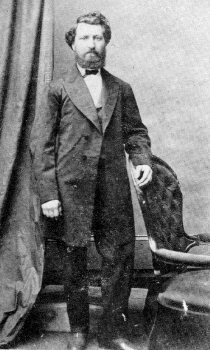
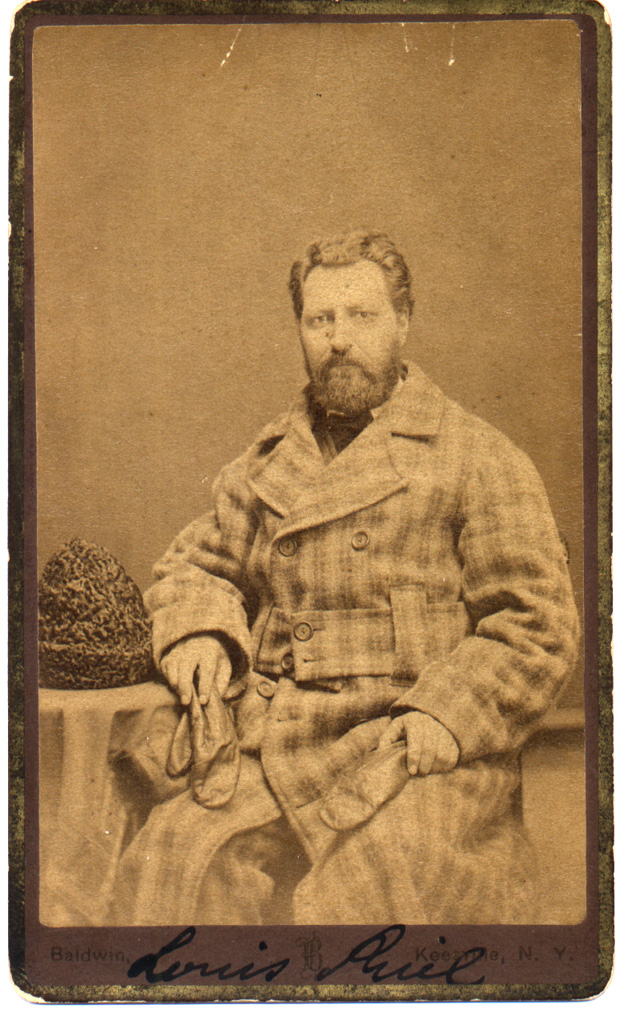
Louis Riel: Patriote Canadien ?

par Rev. Dr. Ed Hird


Qui était Louis Riel ? Était-il un patriote, un dissident, ou les deux ?

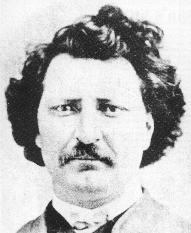
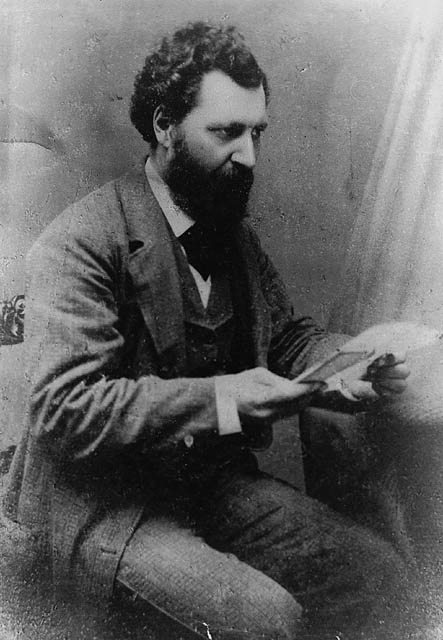
Louis Riel est né à Saint-Boniface (Winnipeg, Manitoba) le 22 octobre 1844, héritant de son père un mélange de sang français, irlandais et indigène, avec le français comme héritage dominant.

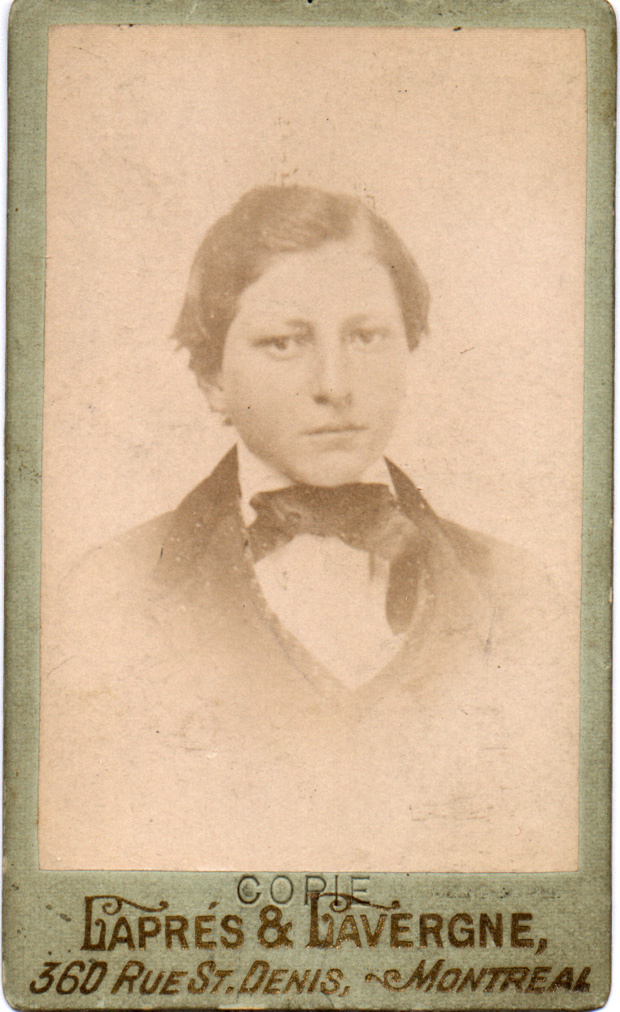
Sa mère, Julie, envoya son fils Louis pour devenir le premier prêtre Metis du Canada. Cependant,  la mort de son père en 1864 pesa fortement sur Louis et entraina une fin abrupte à sa formation au seminaire. Quatre mois avant de devenir prêtre, Louis rencontra une jeune fille de Montréal, en tomba amoureux, et décida de se marier. Il partit de l’université de Montréal sans obtenir son diplome.  Ses plans de mariage se sont alors effondrés quand ses parents de sa fiancée lui interdirent cette union à un Metis. Rendu amer par ce rejet raciste, Riel quitta Montréal en 1866, sans épouse, sans carrière, sans argent.

Retournant chez lui dans la colonie de Red River, Riel constata que les sauterelles avaient dévasté la terre. Avec la cession de l’influence de la Companie de la Baie D’ Hudson, le Canada de l’est et les Etats-Unis semblaient prêts à engloutir la colonie de Red River. Les Metis se sont sentis oubliés, ignorés et abandonnés sur le plan politique.

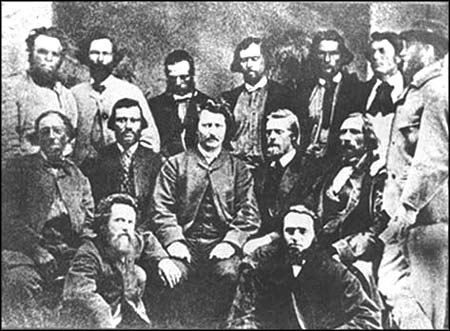
Sans consulter convenablement les 12 000 habitants de Red River, la Compagnie de la Baie d’ Hudson venda la colonie au Canada de l’est. Louis Riel rassembla les Metis en 1869 pour prendre le pouvoir du fort Garry, le centre nerveux de la CBH. Le but de Riel était de forcer le gouvernement fédéral à négocier l’admission du Manitoba dans la confédération comme province officielle, et non comme territoire. Le nom de la provinceManitoba, plutôt que l’Assiniboia, qui était le nom territorial, vena de Louis Riel lui-même.

Louis Riel a proclamé que le Metis étaient les sujets loyaux de sa majesté, la reine de l’Angleterre.  “Si nous sommes des rebelles”, a dit Riel, “nous sommes des rebelles contre la compagnie qui nous vendue, et qui est prête à nous livrer, et contre le Canada qui veut nous acheter. Nous ne sommes pas en révolte  contre la suprématie britannique qui n’a toujours pas donné son approbation pour le transfert final du pays. Nous voulons que les habitants de RedRiver soit un peuple libre”.

Les Américains ont observé la rébellion de Red River avec beaucoup d’intérêt. Ignatius Donnelly, un ancien lieutenant-gouverneur du Minnesota, dit : “Si les revolutionnistesde Red River sont encouragés et soutenus, nous pourrions dans quelques années, peut-être même quelques mois, voir les étoiles et les raies brandir de Fort Garry, des eaux du détroit de Puget Sound, et le long du rivage de Vancouver”. A l’été1870, Nathanial F. Langford et l’ex-gouverneur du Minnesota Marshall ont visité Riel au Fort Garry. Ils ont promis à Riel quatre millions dedollars, des pistolets, des munitions, des mercennaires et des approvisionnements pour se maintenir jusqu’à ce que son gouvernement ait été reconnu par les Etats-Unis. Riel refusa.

Après que William O’Donohogue ait déchiré le drapeau de  l’union Jack, Riel reposta immédiatement l’union Jack avec des ordres de tirer n’importe quel homme qui oserait le toucher. En dépit de sa réputation de rebelle, Louis Riel s’est montré un patriote canadien qui, à lui seul empêcha le Canada occidental d’être absorbé par les Etats-Unis. Riel a écrit cette prière dans son journal intime : Oh mon Dieu! Sauvez-moi du malheur d’être impliqué avec les Etats-Unis. Laissez les Etats-Unis nous protéger indirectement, spontanément, par un acte de providence, mais sans aucun engagement ou accord de notre part”.  Prophétiquement, Riel a également inscrit dans son journal intime: “Dieu m’a révélé que le gouvernement des Etats-Unis va devenir extraordinairement puissant”.

Les Metis sont une bande de lâches”, vantait Thomas Scott. “Ils n’oseront pas me tirer”. S’il n’était pas pour l’approbation de Riel du tir tragique de l’anglais Thomas Scott parRiel, il auraitpu aboutir au Cabinet fédéral de John A.Macdonald. La mort de Thomas Scott a fait de Riel l’homme le plus détesté du Canada.

Après sa fuite aux Etats-Unis, Riel a été alors élu comme MP du Manitoba.

La législature du Québec en1874 a passé une résolution unanime demandant au Gouverneur-Général d’accorder l’amnistie à Riel. La même année, après la réélection de Louis Riel comme MP, il est entré dans le bâtiment du parlement, a signé le registre, et a juré un serment d’allégeance à la Reine Victoria avant de se échapper pour éviter l’arrestation. La Chambre des Communes, outrée, l’a expulsé avec une majorité 56-vote.

Exilé au Montana, Riel s’est marié et est devenu un bon citoyen américain, respectueux des lois. En 1884, avec l’abattage du bison, plusieurs gens de premières nations et Métis mourraient de faim. Les Metis en Saskatchewan ont convaincu Riel de retourner au Canada. Riel a envoyé une pétition à Ottawa exigeant que les Metis recoivent les titres de la terre qu’ils occupaient et que les districts de Saskatchewan, Assiniboia et Alberta recoivent le statut provincial. Au lieu de cela, le gouvernement fédéral a établit une commission. En l’absence d’action concrète, Louis Riel et ses partisans ont décidé de renouveller leurs révendications en essayant de capturer le fort Carlton.

En raison du chemin de fer du Canadien Pacifique, mon arrière-grand-père Oliver Allen a été envoyé avec la milice de Toronto pour rapidement vaincre Riel à Batoche. Avec des pistolets Gatling américains avec 1.200 séries par minute, la bataille n’a pas duré longtemps. Tandis qu’il était dans l’ouest, Oliver Allen rencontra sa future épouse Mary Mclean, une journaliste de Regina bien disposé à l’égard de Louis Riel. Juste avant la pendaison de Riel, Mary Mclean s’est déguisé en prêtre catholique afin d’interviewer Riel, il a ecrit cette prière dans son journal intime : “Seigneur Jésus, je vous aime. J’aime tout lié à vous… Seigneur Jésus, faites-moi la même faveur que vous avez fait pour le bon voleur ; dans votre pitié infinie, laissez-moi entrer au paradis le jour même de ma mort”.

Tour Rev. Dr. Ed Et Marc Hird,

Un article pour les nouvelles du Rivage de Nord « Parlant Spirituel » Colonne

-award-winning author of the book Battle for the Soul of Canada

P. S. Click this Amazon link to view for free the first two chapters of our new novel Blue Sky.

“I’m afraid there’s been an accident…”

12bdf6ff-3021-4e73-bccd-bc919398d1a0-7068-0000031133e7b4d9Sandy Brown and her family have just moved to Spokane, Washington where her husband, Scott, is pastoring a new church. With a fresh start, Sandy is determined to devote more time to her four children. But, within weeks of settling in their new life, the Brown family is plunged into turmoil.

Sandy receives shocking news that her children aren’t safe, which brings back haunting memories of the trauma she experienced as a girl. Then, the unthinkable happens…

A brutal attack puts Sandy on the brink of losing everything she’s loved. Her faith in God and the family she cherishes are pushed to the ultimate limit.

Is healing possible when so many loved ones are hurt? Are miracles really possible through the power of prayer? Can life return to the way it was before?

Blue Sky reveals how a mother’s most basic instinct isn’t for survival… but for family.

If you’re a fan of Karen Kingsbury, then you’ll love Blue Sky. Get your copy today on paperback or  kindle.

-Click to check out our marriage book For Better For Worse: discovering the keys to a lasting relationship on Amazon. You can even read the first two chapters for free to see if the book speaks to you.

  •  

-The sequel book Restoring Health: body, mind and spirit is available online with Amazon.com in both paperback and ebook form.  Dr. JI Packer wrote the foreword, saying “I heartily commend what he has written.” The book focuses on strengthening a new generation of healthy leaders. Drawing on examples from Titus’ healthy leadership in the pirate island of Crete, it shows how we can embrace a holistically healthy life.

In Canada, Amazon.ca has the book available in paperback and ebook. It is also posted on Amazon UK (paperback and ebook), Amazon France (paperback and ebook), and Amazon Germany (paperback and ebook).

Restoring Health is also available online on Barnes and Noble in both paperback and Nook/ebook form.  Nook gives a sample of the book to read online.

Indigo also offers the paperback and the Kobo ebook version.  You can also obtain it through ITunes as an IBook.

To receive a signed copy within North America, just etransfer at ed_hird@telus.net, giving your address. Cheques are also acceptable. Pour recevoir une copie signée en Amérique du Nord, transférez simplement à ed_hird@telus.net, en indiquant votre adresse. Les chèques sont également acceptés.

-Click to purchase the Companion Bible Study by Jan Cox (for the Battle of the Soul of Canada) in both paperback and Kindle on Amazon.com and Amazon.ca 

Indigo also offers the paperback and the Kobo ebook version.  You can also obtain it through ITunes as an IBook.

-Click to purchase the Companion Bible Study by Jan Cox (for the Battle of the Soul of Canada) in both paperback and Kindle on Amazon.com and Amazon.ca

To purchase any of our six books in paperback or ebook on Amazon, just click on this link.

Pour acheter l'un de nos six livres en livre de poche ou en ebook sur Amazon, cliquez simplement sur ce lien.


Leave a comment

La passion de Louis Riel

par Rev Dr Ed Hird


‘La  première fois que j’ai reçu l’eucharistie sainte, je tremblais,’ a dit Louis Riel. Né à St Boniface (Winnipeg) le  22 octobre, 1844, le jeune Louis Riel a eu un esprit très sensible et passionné avec un manque de tolérance pour l’intimidation.  Selon Mousseau, « rien  ne l’a irrité autant qu’un abus de force contre le faible. »   Riel a également eu une vie profonde de prière et du jeûne, commentant en son journal intime : « Le jeûne et la  prière sont les deux grandes clefs au succès à temps et l’éternité.  Rien ne peut résister jeûner quand il est fait avec l’humilité, la sincérité et la dévotion. Le jeûne ouvre des prisons et libère les criminelles.  Trois ou quatre jours de jeûne accomplissent-ils plus qu’une armée sur le champ de bataille… »

Sa mère, Julie, avait voulu être une nonne. Au lieu de cela elle a envoyé son fils prairie-né par le Red River en 1858 à Montréal pour devenir le premier prêtre Métis du Canada.  Riel a été profondément effectuer par la spiritualité de sa mère, notant que « les caractéristiques  réfléchissantes et calmes de ma mère, avec ses yeux constamment tournés vers le ciel, son respect, son attention, sa dévotion à ses engagements religieux, ont toujours laissé sur moi l’impression la plus profonde de son bon exemple. »  Riel a été très centré sur Christ, priant en son journal intime : « Lord Jésus, je t’aime. J’aime tout lier à vous. »

Vous pouvez imaginer le choc de sa mère quand Louis a abandonné l’université de Montréal seulement quatre mois avant de son ordination. Louis est allé vivre avec les nonnes grises dans leur couvent. La mort récente de son père avait pesé très fortement sur Louis comme la nouvelle tête de la famille Riel. De plus compliquer ses plans d’ordination, il s’était secrètement fiancé à Marie Julie Guernon, seulement d’avoir les   fiançailles annulées par ses parents racistes. En son journal intime, Riel a commenté : ‘Les hommes peuvent lutter contre la volonté de Dieu et s’opposent à sa réalisation, mais ils ne réussissent jamais à l’exclure des conseils des affaires humaines. Dieu a tout dans son soin. Ayez la confiance en Jésus Christ.’

Retournant à Winnipeg, il a découvert la dévastation agricole, sociale, et politique, particulièrement parmi son peuple, les Métis. Quand Riel défendait les droites des Métis, il a réveillé notre nation somnolente du Canada. Après avoir repris le fort Garry de la Compagnie de la Baie D’Hudson, Riel a forcé avec succès le Premier ministre MacDonald à d’identifier des droites de terre des Métis, et d’accepter Manitoba dans la confédération comme province, et pas simplement comme un territoire. Riel a indiqué au négociateur fédéral Donald Smith : « Nous voulons seulement nos droites justes comme des sujets britanniques, et nous voudrions que les Anglais nous joignent simplement pour obtenir ces droits. »  Le 12 mai, 1870, l’acte de Manitoba, basé sur le Métis “liste des droites,” a été ratifié par le Parlement canadien.

La tragédie de la rébellion de Red River était le tir de Thomas Scott que Riel a autorisé. En conséquence, le Canada de l’est ne se contenterait pas avec moins que la tête de Riel sur un plat. Les troupes de colonel Wolseley ont voulu le sang.  Laissant le fort Garry, Riel a dit, « Nous avons fuit  parce qu’il semble que nous avons été trompés. »  L’évêque Tache plus tard a dit concernant l’amnistie promise : ‘L’honorable John MacDonald a menti comme un ‘trooper’. »

En s’échappant aux Etats-Unis, Riel s’est soulagé, disant : « N’importe ce qui se passe maintenant, les droites du Métis sont assurées par l’acte de Manitoba ; c’est ce que je voulais- ma mission est fini. »  Écrivant à son bon ami, l’évêque Tache, le 9 septembre 1870, Riel a dit : « Ma vie appartient au Seigneur. Laisse-le faire ce qu’il souhaite avec elle.’

La période de l’exil aux Etats-Unis était très douloureuse pour Louis Riel. L’évêque Bourget a soulagé Riel en lui indiquant que « …Le Seigneur, qui vous a toujours mené et vous a aidé jusqu’à présent, ne vous abandonnera pas dans les heures les plus foncées de votre vie. Parce qu’Il vous a donné une mission que vous devez accomplir à tous les égards. »  Riel a commencé à se déplacer plus dans le prophétique, parfois éprouvant la joie intense et la douleur profonde dans des offices. Avec un grand effort, Riel a essayé de supprimer ses larmes : « Ma douleur était aussi intense que ma joie. »

Au journal intime de Riel, il a mémorablement dit : « L’Esprit de Dieu a pénétré mon cerveau dès que j’ai commencé à dormir.  L’Esprit de Dieu nous affecte où Il souhaite, et dans la mesure qu’Il voudrait. »

À cause de l’intensité de ses expériences spirituelles, ses amis ont caché Riel dans un asile aliéné de Montréal. Après avoir été libéré en 1878, Riel a commenté : «Je faisais semblant d’être fou. J’ai réussi si bon que tout le monde ait cru que j’étais vraiment fou. » La folie de Riel était peut-être comme la folie simulée du roi David avant les Philistins (1 Samuel 18:13).  Riel a indiqué : « Si je disparais ou si je perds mon esprit, leur persécution implacable peut-être relâcherait… Donc mes ennemis cesseraient probablement de persécuter mon peuple Métis. »

En 1884, Riel est revenu du Montana avec sa famille, à la demande pressante des Métis affamés, à Batoche, Saskatchewan. Wilfrid Laurier, être plus tard Premier ministre libéral, plus tard avoué sur le plancher de la Chambre des Communes : « Si j’étais né sur les banques de la Saskatchewan, j’aurais épaulé moi-même un mousquet au combat contre la négligence des gouvernements et l’avarice sans scrupule des spéculateurs. »  Riel a pétitionné sans succès le gouvernement fédéral avant d’essayer de conquérir le fort Carlton. « Je peux presque le dire, »  Louis Riel a indiqué, « notre cause secoue la confédération canadienne d’une extrémité du pays à l’autre. Il gagne de force chaque jour. »

Cependant la cause de Riel  a été militairement condamnée. La plupart des 250 Métis avaient des fusils de chasse ou de vieux museau-chargeurs, mais quelques-uns ont eu seulement des arcs et des flèches. La milice de Toronto, qui incluait mon grand-grand-père Oliver Allen et 1,000 autres hommes, a eu des Sniders, des Winchesters, des canons et un pistolet de Gatling, le précurseur de la mitrailleuse. Le pistolet de Gatling leur avait été prêté par l’armée des USA, et actionné par un lieutenant américain, Arthur Howard. Tout en conquérant Riel, mon grand-grand-père a rencontré ma grand-grand-mère, Mary Mclean, qui était une journaliste de ‘Regina Leader’ bien disposée à l’égard de Louis Riel. Juste avant la pendaison de Riel, Mary Mclean, qui parlait le français couramment, s’est déguisé en prêtre catholique afin d’interviewer Riel. Son rédacteur de journal lui avait indiqué : « Vous devez avoir une interview avec Riel si vous devez surpasser la force entière de police dans le Nord-Ouest. » Riel a dit à mon grand-grand-mère le 19 novembre 1885 : « Quand je vous ai vu la première fois au procès, je vous ai aimé. »  Peu de temps après, mes grand-grand-pères Oliver et Mary se sont épousés et déménager pour commencer la vie à nouveau en Colombie Britannique.

Avant que Riel soit mort, il a passionnément prié en son journal intime : « Jésus, auteur de la vie ! Soutenez-nous dans toutes les batailles de cette vie et, sur notre dernier jour, donnez-nous la vie éternelle. Jésus, donnez-moi la grâce de savoir vraiment votre beauté ! Donnez-moi la grâce de vous aimer vraiment. Jésus, accordez-moi la grâce de savoir comment beau vous êtes ; accorde-moi la grâce de vous chérir. »

Ma prière  est que nous aussi pouvons découvrir la passion de Louis Riel pour son sauveur Jésus Christ.


Révérend Dr Ed Hird, BSW, MDiv, DMin

-previously published in the North Shore News/Deep Cove Crier

-award-winning author of the book Battle for the Soul of Canada

P. S. Click this Amazon link to view for free the first two chapters of our new novel Blue Sky.

“I’m afraid there’s been an accident…”

12bdf6ff-3021-4e73-bccd-bc919398d1a0-7068-0000031133e7b4d9Sandy Brown and her family have just moved to Spokane, Washington where her husband, Scott, is pastoring a new church. With a fresh start, Sandy is determined to devote more time to her four children. But, within weeks of settling in their new life, the Brown family is plunged into turmoil.

Sandy receives shocking news that her children aren’t safe, which brings back haunting memories of the trauma she experienced as a girl. Then, the unthinkable happens…

A brutal attack puts Sandy on the brink of losing everything she’s loved. Her faith in God and the family she cherishes are pushed to the ultimate limit.

Is healing possible when so many loved ones are hurt? Are miracles really possible through the power of prayer? Can life return to the way it was before?

Blue Sky reveals how a mother’s most basic instinct isn’t for survival… but for family.

If you’re a fan of Karen Kingsbury, then you’ll love Blue Sky. Get your copy today on paperback or  kindle.

-Click to check out our marriage book For Better For Worse: discovering the keys to a lasting relationship on Amazon. You can even read the first two chapters for free to see if the book speaks to you.

  •  

-The sequel book Restoring Health: body, mind and spirit is available online with Amazon.com in both paperback and ebook form.  Dr. JI Packer wrote the foreword, saying “I heartily commend what he has written.” The book focuses on strengthening a new generation of healthy leaders. Drawing on examples from Titus’ healthy leadership in the pirate island of Crete, it shows how we can embrace a holistically healthy life.

In Canada, Amazon.ca has the book available in paperback and ebook. It is also posted on Amazon UK (paperback and ebook), Amazon France (paperback and ebook), and Amazon Germany (paperback and ebook).

Restoring Health is also available online on Barnes and Noble in both paperback and Nook/ebook form.  Nook gives a sample of the book to read online.

Indigo also offers the paperback and the Kobo ebook version.  You can also obtain it through ITunes as an IBook.

To receive a signed copy within North America, just etransfer at ed_hird@telus.net, giving your address. Cheques are also acceptable. Pour recevoir une copie signée en Amérique du Nord, transférez simplement à ed_hird@telus.net, en indiquant votre adresse. Les chèques sont également acceptés.

-Click to purchase the Companion Bible Study by Jan Cox (for the Battle of the Soul of Canada) in both paperback and Kindle on Amazon.com and Amazon.ca 

Indigo also offers the paperback and the Kobo ebook version.  You can also obtain it through ITunes as an IBook.

-Click to purchase the Companion Bible Study by Jan Cox (for the Battle of the Soul of Canada) in both paperback and Kindle on Amazon.com and Amazon.ca


To purchase any of our six books in paperback or ebook on Amazon, just click on this link.
Pour acheter l'un de nos six livres en livre de poche ou en ebook sur Amazon, cliquez simplement sur ce lien.


2 Comments

The Passion of Louis Riel

By the Rev. Dr. Ed Hird


‘The first time I received the Holy Eucharist, I was trembling,” said Louis Riel.  Born at St. Boniface (Winnipeg) on October 22nd 1844, young Louis Riel had a very sensitive, passionate spirit with zero tolerance for bullying.  According to Mousseau, ‘nothing irritated him as much as an abuse of strength against the weak.’  Riel also had a deep life of prayer and fasting, commenting in his diary: “Fasting and prayer are the two great keys to success in time and eternity…Nothing can resist fasting when it is done with humility, sincerity and devotion.  Fasting opens prisons and releases the most hardened criminals…Three or four days of fasting accomplish more than an army on the field of battle…”


His mother Julie had wanted to be a nun.  Instead she sent her Red River prairie-born son in 1858 to Montreal to become Canada’s first Metis priest.  Riel was deeply impacted by his mother’s spirituality, noting that “the calm reflective features of my mother, her eyes constantly toward towards heaven, her respect, her attention, her devotion to her religious obligations always left upon me the deepest impression of her good example.” Riel was very Christ-centered, praying in his diary: “Lord Jesus, I love you.  I love everything associated with You.”


You can imagine the shock to his mother when Louis dropped out of the College of Montreal just four months before his ordination. Louis went to live with the Grey Nuns in their convent.  His father’s recent death had weighed very heavily on Louis as the new head of the Riel family.  Also complicating his ordination plans was that he had secretly become engaged to Marie Julie Guernon, only to have the engagement quashed by her racist parents.  In his diary, Riel commented: “Men can struggle as they will against the will of God and oppose its fulfillment, but they never succeed in excluding it from the guidance of human affairs.  God has everything in His care.  Have confidence in Jesus Christ…”


Returning to Winnipeg, he discovered agricultural, social, and political devastation, especially among his Metis people.  When Riel stood up for the rights of the Metis, he woke up our sleepy Canada nation.  After taking over the Hudson Bay Company’s Fort Garry, Riel successfully forced Prime Minister MacDonald to recognize Metis land rights, and to accept Manitoba into Confederation as a full Province, and not just another territory.  Riel stated to the Federal negotiator Donald Smith: ‘We want only our just rights as British subjects, and we want the English to join us simply to obtain these.’  On May 12, 1870, the Manitoba Act, based on the Métis “List of Rights,” was passed by the Canadian Parliament.


The tragedy of the Red River Rebellion was the Riel-authorized shooting of Thomas Scott.  As a result, Eastern Canada would settle for nothing less than Riel’s head on a platter.  Colonel Wolseley’s troops wanted blood.  Leaving Fort Garry, Riel said: “We have fled because it appears that we have been deceived.”  Bishop Tache later said regarding the promised amnesty: ‘The Rt. Honourable John A MacDonald lied like a trooper’


In escaping to the USA, Riel comforted himself, saying: “No matter what happens now, the rights of the Metis are assured by the Manitoba Act; that is what I wanted –my mission is finished.”  Writing to his good friend Bishop Tache on Sept 9th 1870, Riel said: “My life belongs to God.  Let him do what He wishes with it.”


The time of exile in the USA was very painful for Louis Riel.  Bishop Bourget comforted Riel telling him that “…God, who has always led you and assisted you up to the present time, will not abandon you in the darkest hours of your life.  For he has given you a mission which you must fulfill in all respects.”  Riel began to move more in the prophetic, sometimes experiencing intense joy and deep sorrow in church services. With a great effort, Riel tried to suppress his weeping: “My pain was as intense as my joy”.  In Riel’s diary, he memorably said: “The Spirit of God penetrated my brain as soon as I fell asleep…The Spirit of God affects us where He wishes, and to the extent that suits Him.”


Because of the intensity of his spiritual experiences, his friends hid Riel in a Montreal insane asylum.  After being released in 1878, Riel commented: “I did pretend to be mad.  I succeeded so well that everybody believed that I really was mad.”  Perhaps Riel’s insanity was like King David’s feigned insanity before the Philistines (1 Samuel 18:13).  Riel stated: “If I did disappear or if I should lose my mind, their relentless persecution may be relaxed…Then my enemies would probably cease persecuting my Metis people.”


In 1884, Riel returned from Montana with his family, at the urgent request of the starving Metis, to Batoche, Saskatchewan. Wilfrid Laurier, later to be Liberal Prime Minister, later declared on the floor of the House of Commons: “Had I been born on the banks of the Saskatchewan, I would myself have shouldered a musket to fight against the neglect of governments and the shameless greed of speculators.”  Riel unsuccessfully petitioned the federal government before attempting to capture Fort Carlton.  “I can almost say it”, noted Louis Riel, “our cause is shaking the Canadian Confederation from one end of the country to the other.  It is gaining strength daily.”


Riel’s cause however was militarily doomed.  Most of the 250 Metis had shotguns or old muzzle-loaders, but a few had only bows and arrows.  My great-grandfather Oliver Allen, as part of the 1,000-strong Toronto militia, had Sniders, Winchesters, cannon and a Gatling gun- the forerunner of the machine gun.  The Gatling gun had been loaned to them by the US Army, and operated by an American Lieutenant Arthur Howard. While conquering Riel, my great-grandfather met my great-grandmother Mary Mclean a Regina Leader news-reporter sympathetic to Louis Riel.  Right before Riel’s hanging, Mary Mclean, who was fluent in French, disguised herself as a Catholic priest in order to interview Riel.  Her newspaper editor Nicholas Flood Davin had told her: “An interview must be had with Riel if you have to outwit the whole police force of the North-west.” Riel said to my great-grandmother on Nov 19th 1885: “When I first saw you at the trial, I loved you.” Shortly after, my great-grandparents Oliver and Mary married and relocated to start life anew in BC!

Sadly, because reporters were not given bylines in those days, my greatgrandmother Mary Mclean was not always acknowledged by historians.  Some even falsely suggested until recently that Nicholas Flood Davin was the pretend Catholic priest/reporter loved by Riel.

Before Riel died, he passionately prayed in his diary: “Jesus, author of life!  Sustain us in all the battles of this life and, on our last day, give us eternal life.  Jesus, give me the grace to really know your beauty!  Grant me the grace to really love You.  Jesus, grant me the grace to know how beautiful You are; grant me the grace to cherish You.”

My prayer for those reading this article is that we too may discover the passion of Louis Riel for his Saviour Jesus Christ.


The Rev. Dr. Ed Hird, BSW, MDiv, DMin

-previously published in the North Shore News/Deep Cove Crier

-award-winning author of the book Battle for the Soul of Canada

P. S. Click this Amazon link to view for free the first two chapters of our new novel Blue Sky.

“I’m afraid there’s been an accident…”

12bdf6ff-3021-4e73-bccd-bc919398d1a0-7068-0000031133e7b4d9Sandy Brown and her family have just moved to Spokane, Washington where her husband, Scott, is pastoring a new church. With a fresh start, Sandy is determined to devote more time to her four children. But, within weeks of settling in their new life, the Brown family is plunged into turmoil.

Sandy receives shocking news that her children aren’t safe, which brings back haunting memories of the trauma she experienced as a girl. Then, the unthinkable happens…

A brutal attack puts Sandy on the brink of losing everything she’s loved. Her faith in God and the family she cherishes are pushed to the ultimate limit.

Is healing possible when so many loved ones are hurt? Are miracles really possible through the power of prayer? Can life return to the way it was before?

Blue Sky reveals how a mother’s most basic instinct isn’t for survival… but for family.

If you’re a fan of Karen Kingsbury, then you’ll love Blue Sky. Get your copy today on paperback or  kindle.

-Click to check out our marriage book For Better For Worse: discovering the keys to a lasting relationship on Amazon. You can even read the first two chapters for free to see if the book speaks to you.

  •  

-The sequel book Restoring Health: body, mind and spirit is available online with Amazon.com in both paperback and ebook form.  Dr. JI Packer wrote the foreword, saying “I heartily commend what he has written.” The book focuses on strengthening a new generation of healthy leaders. Drawing on examples from Titus’ healthy leadership in the pirate island of Crete, it shows how we can embrace a holistically healthy life.

In Canada, Amazon.ca has the book available in paperback and ebook. It is also posted on Amazon UK (paperback and ebook), Amazon France (paperback and ebook), and Amazon Germany (paperback and ebook).

Restoring Health is also available online on Barnes and Noble in both paperback and Nook/ebook form.  Nook gives a sample of the book to read online.

Indigo also offers the paperback and the Kobo ebook version.  You can also obtain it through ITunes as an IBook.

To receive a signed copy within North America, just etransfer at ed_hird@telus.net, giving your address. Cheques are also acceptable.

-Click to purchase the Companion Bible Study by Jan Cox (for the Battle of the Soul of Canada) in both paperback and Kindle on Amazon.com and Amazon.ca 

Indigo also offers the paperback and the Kobo ebook version.  You can also obtain it through ITunes as an IBook.

-Click to purchase the Companion Bible Study by Jan Cox (for the Battle of the Soul of Canada) in both paperback and Kindle on Amazon.com and Amazon.ca

To purchase any of our six books in paperback or ebook on Amazon, just click on this link.


6 Comments

Louis Riel: Canadian Patriot?

By the Rev. Dr. Ed and Mark Hird


Who was Louis Riel?  Was he a patriot or a dissident or both?


Louis Riel was born at St. Boniface (Winnipeg, Manitoba) on October 22nd 1844, inheriting from his father a mixture of French, Irish and Aboriginal blood, with French predominating.


Louis’ mother Julie sent her son Louis to become Canada’s first Metis priest.  The 1864 death of his father however weighed heavily on Louis, bringing about an abrupt end to his seminary training.  Four months from becoming a priest, Louis met a young Montreal girl, fell in love, and decided to marry.  He rashly left the College of Montreal without obtaining his degree, and then his marriage plans collapsed when his fiancée’s parents forbade this proposed union with a Metis.  Embittered by this racist-rejection, Riel left Montreal in 1866 – without a wife, without a career, without money.


Returning home to the Red River settlement, Riel found that locusts had devastated the land. With the demise of the Hudson Bay Company’s influence, both Eastern Canada and the United States seemed poised to swallow up the Red River settlement.  The Metis felt forgotten, ignored and politically abandoned.


Without adequately consulting the local 12,000 Red River people, the Hudson Bay Company sold the Red River settlement to Eastern Canada.  Louis Riel rallied the Metis people in 1869 to take over the local Fort Garry, the Western nerve centre of the HBC.  Riel’s goal was to force the Federal Government to negotiate Manitoba’s admission into Confederation as a full province, not just a territory. The provincial name Manitoba, rather than the expected territorial name Assiniboia, came from Louis Riel himself.


Louis Riel proclaimed that the Metis were ‘loyal subjects of Her Majesty the Queen of England’. “If we are rebels, said Riel, “we are rebels against the Company that sold us, and is ready to hand us over, and against Canada that wants to buy us.  We are not in rebellion against the British supremacy which has still not given its approval for the final transfer of the country…We want the people of Red River to be a free people…”


The Americans watched the Red River Rebellion with keen interest.  Ignatius Donnelly, a former Lieutenant Governor of Minnesota, said: ‘If the revolutionists of Red River are encouraged and sustained…, we may within a few years, perhaps months, see the Stars and Stripes wave from Fort Garry, from the waters of Puget Sound, and along the shore of Vancouver.’  In the summer of 1870, Nathanial F. Langford and ex-governor Marshall of Minnesota visited Riel at Fort Garry.  They promised Riel $4 million cash, guns, ammunition, mercenaries and supplies to maintain himself until his government was recognized by the United States.  Riel declined.


After William O’Donohogue ripped down the Union Jack, Riel immediately reposted the Union Jack with orders to shoot any man who dared touch it.  Despite his rebellious reputation, Louis Riel showed himself to be a Canadian patriot who single-handedly kept Western Canada from being absorbed by the USA.  Riel prayed in his diary: “O my God!  Save me from the misfortune of getting involved with the United States.  Let the United States protect us indirectly, spontaneously, through an act of Providence, but not through any commitment or agreement on our part.”  Riel also prophetically noted in his diary: “God revealed to me that the government of the United States is going to become extraordinarily powerful.”


“The Metis are a pack of cowards”, boasted Thomas Scott, “They will not dare to shoot me.” If it was not for Riel’s sanctioning of the tragic shooting of the Orangeman Thomas Scott, he might have ended up in John A Macdonald’s federal Cabinet.  Thomas Scott’s death made Riel ‘Canada’s most hated man’.


After fleeing to the United States, Riel was then elected in his absence as a Manitoba MP. The Quebec legislature in 1874 passed a unanimous resolution asking the Governor-General to grant amnesty to Riel.  That same year, after Louis Riel’s re-election as MP, he entered the parliament building, signed the register, and swore an oath of allegiance to Queen Victoria before slipping out to avoid arrest.  The outraged House of Commons expelled him by a 56-vote majority.


Exiled to Montana, Riel married and became a law-abiding American citizen. In 1884, with the slaughtering of the buffalo, many First Nations and Métis were dying of hunger.  The Metis in Saskatchewan convinced Riel to return to Canada.  Riel sent a petition to Ottawa demanding that the Metis be given title to the land they occupied and that the districts of Saskatchewan, Assiniboia and Alberta be granted provincial status.  The Federal Government instead set up a commission.  In the absence of concrete action, Louis Riel and his followers decided to press their claims by the attempted capture of Fort Carlton.


Due to the Canadian Pacific Railway, my great-grandfather Oliver Allen was shipped with the Toronto militia to quickly defeat Riel at Batoche.  Using an American Gatling gun with 1,200 rounds a minute, the battle did not last long.  While in the West, Oliver Allen met his future wife Mary Mclean a Regina Leader news-reporter sympathetic to Louis Riel.  Right before Riel’s hanging, Mary Mclean disguised herself as a Catholic priest in order to interview Riel.  Before Riel died, he prayed in his diary: “Lord Jesus, I love you.  I love everything associated with You…Lord Jesus, do the same favour for me that You did for the Good Thief; in Your infinite mercy, let me enter Paradise with You the very day of my death.”


The Rev. Dr. Ed Hird, BSW, MDiv, DMin

-previously published in the North Shore News

-award-winning author of the book ‘Battle for the Soul of Canada’

P. S. Click this Amazon link to view for free the first two chapters of our new novel Blue Sky.

“I’m afraid there’s been an accident…”

12bdf6ff-3021-4e73-bccd-bc919398d1a0-7068-0000031133e7b4d9Sandy Brown and her family have just moved to Spokane, Washington where her husband, Scott, is pastoring a new church. With a fresh start, Sandy is determined to devote more time to her four children. But, within weeks of settling in their new life, the Brown family is plunged into turmoil.

Sandy receives shocking news that her children aren’t safe, which brings back haunting memories of the trauma she experienced as a girl. Then, the unthinkable happens…

A brutal attack puts Sandy on the brink of losing everything she’s loved. Her faith in God and the family she cherishes are pushed to the ultimate limit.

Is healing possible when so many loved ones are hurt? Are miracles really possible through the power of prayer? Can life return to the way it was before?

Blue Sky reveals how a mother’s most basic instinct isn’t for survival… but for family.

If you’re a fan of Karen Kingsbury, then you’ll love Blue Sky. Get your copy today on paperback or  kindle.

-Click to check out our marriage book For Better For Worse: discovering the keys to a lasting relationship on Amazon. You can even read the first two chapters for free to see if the book speaks to you.

  •  

-The sequel book Restoring Health: body, mind and spirit is available online with Amazon.com in both paperback and ebook form.  Dr. JI Packer wrote the foreword, saying “I heartily commend what he has written.” The book focuses on strengthening a new generation of healthy leaders. Drawing on examples from Titus’ healthy leadership in the pirate island of Crete, it shows how we can embrace a holistically healthy life.

In Canada, Amazon.ca has the book available in paperback and ebook. It is also posted on Amazon UK (paperback and ebook), Amazon France (paperback and ebook), and Amazon Germany (paperback and ebook).

Restoring Health is also available online on Barnes and Noble in both paperback and Nook/ebook form.  Nook gives a sample of the book to read online.

Indigo also offers the paperback and the Kobo ebook version.  You can also obtain it through ITunes as an IBook.

To receive a signed copy within North America, just etransfer at ed_hird@telus.net, giving your address. Cheques are also acceptable.

-Click to purchase the Companion Bible Study by Jan Cox (for the Battle of the Soul of Canada) in both paperback and Kindle on Amazon.com and Amazon.ca 

Indigo also offers the paperback and the Kobo ebook version.  You can also obtain it through ITunes as an IBook.

-Click to purchase the Companion Bible Study by Jan Cox (for the Battle of the Soul of Canada) in both paperback and Kindle on Amazon.com and Amazon.ca 

To purchase any of our six books in paperback or ebook on Amazon, just click on this link.


1 Comment

Samuel and Helene de Champlain: A Canadian Romance

by the Rev. Dr. Ed Hird


Before Samuel & Helene de Champlain came on the scene, the very word ‘Canada’ had become a joke in France, thanks to Jacques Cartier bringing back quartz and ‘fool’s gold’ from Canada.  The term ‘diamond of Canada’ became a symbol for deception and emptiness.  During Champlain’s lifetime, France largely ignored him.  To most French citizens, Canada seemed distant and unimportant.  Even well-educated Parisians denied the value of Canada, sometimes dismissing it as another Siberia.


In the 16th century, France’s population was six times that of England, it possessed as much coastline, it was more affluent, its sailors were more skilled and were the first to consistently visit the Canadian seaboard.  But in contrast to England, there was little vision in France for the priority of sending people to the New World.  To immigrate to Canada, there was even a financial disincentive of 36 livres charged to anyone leaving France.  As a result, Champlain and his Quebec people felt disregarded, deserted and discarded.  King Louis XIII even had the thoughtlessness to cancel Champlain’s modest pension of six hundred livres granted by Henry IV; forcing Champlain to successfully implore for its reinstatement.


Champlain was born in 1567 in the town of Brouage, then a bustling seaport on the southwestern coast of France, some 70 miles (112 km) north of Bordeaux. His father was a sea captain and as a boy he became skilled at seamanship and navigation.  Champlain later commented: “…(Navigation) is the art…which led me to explore the coast of America, especially New France, where I have always desired to see the fleur-de-lys flourish.”  Ironically Champlain never learned to swim, even after crossing the rugged Atlantic Ocean twenty-nine times, as he thought swimming was too risky.


For a while Champlain served in the army of King Henry IV, fighting alongside Martin Frobisher in a joint undertaking by the British and French against the Spanish.  In 1599 Champlain captained a ship which returned Spanish prisoners-of-war, allowing him to explore the Spanish-controlled West Indies and Mexico.  As a result of his travels, Champlain prophetically suggested the idea of making a canal across Central America to shorten the trip to the southern Pacific Ocean.  King Henry IV was so impressed by Champlain’s map-making work that he granted him a lifetime income.  Henri IV also gave Champlain the title ‘de’, which marked him as a man of noble rank.


Four hundred and seven years ago, in 1603, Samuel de Champlain traveled up the St. Lawrence River to the site of present day Montreal, the First Nations village of Hochelaga.  In Champlain’s 1604 Journal, he wrote: “So many voyages and discoveries without result, and attended with so much hardship and expense, have caused us French in late years to attempt a permanent settlement in those lands which we call New France.”  After two Acadian colonizing attempts at St. Croix and Port Annapolis in the Maritimes, Champlain turned his eyes to the future Quebec City, a name that he translated from an aboriginal word: ‘where the river narrows.’  Quebec City, the Iroquois village of Stadacona, became the earliest enduring city north of Mexico City and Florida settled by Europeans.


Life was not easy for Champlain at Quebec City.  While building a miniature Bastille-like ‘habitation’, Champlain had to stamp out an attempted murder plot against himself.  When spring finally broke up the ice in April 1609, only eight of Champlain’s 24 men who wintered at Quebec were still alive.


Champlain cared deeply about the First Nations people, building lasting friendships with many groups.  Pere Lalemant in 1640 wrote: ‘Would God that all the French, who were the first to come into these regions, had been like him!’ Champlain spoke prophetically to a gathering of the Montagnais, Algonkin, and French: “Our sons shall wed your daughters and henceforth we shall be one people”


When Samuel de Champlain married Hélène Boullé on December 30, 1610 in Paris, she was only 12 years old while he was approximately forty!  She was so young that her father insisted that she live at home for at least another two years.  At age 21, she moved to Quebec City.  The First Nations were intrigued by Helene who loved them dearly in return.  A titled lady with elegant outfits and etiquette, Helene was the center of attention at Quebec.  But for her the settlement held little joy.  Unlike Paris, Quebec had no shops, lively crowds or interesting chitchat.  As a high-spirited twenty-five-year-old, she pined for the exhilaration of Paris.  Champlain, fifty-six, favored the companionship of his hardy French and aboriginal voyageurs and the untainted grandeur of the Canadian outback.  And so, after four years, Champlain and Helene tragically parted ways.  Out of love, Champlain named the ‘Montreal Expo 67’ Island after her: Isle Saint Helene.  When Helene learned of her husband’s death in 1635, she entered a convent, choosing to become a nun rather than to marry again.


More than half of the fur-trading merchants working with Champlain were Huguenot (French Protestants) from La Rochelle; France.  The 1598 Edict of Nantes, which gave them religious freedom in Quebec and France, was first restricted in 1625 and finally revoked in 1685.  Although the Huguenot were therefore forbidden to worship in Canada by royal decree, the crews of Huguenot ships could not be restrained from holding services on board when in harbour.  The Huguenot loved to sing the psalms in French, a practice first encouraged and then outlawed by the French Royal Court.  Both Champlain and his wife Helene had been raised in Huguenot homes.  So thanks to Champlain, it was agreed that the Huguenot could hold prayer meetings on the ships, but sing psalms only at sea where no one else could hear.


After the English under British Commander David Kirke blockaded the French relief supply ships, Champlain and his men nearly starved, surviving mostly on eels purchased from the Indians and on roots & wood-bark. Champlain was forced to surrender in 1628 to David Kirke’s brothers and was sent for four years to England.  The Treaty of Saint Germain-en-Laye was signed in 1632 which brought Champlain back to Quebec City, much of which had been burnt to the ground by the British.  After having devoted the last 32 years of his life to Canada, Champlain died of a stroke in 1635 at age 68.


Champlain was the most versatile of Canadian pioneers, at once sailor and soldier, writer and entrepreneur, artist and voyageur, visionary and pragmatist.  He wrote four important books relating Canada’s early history.  He produced the best North American maps and its earliest harbour charts.  Repeatedly Champlain put his life in jeopardy in order to discover routes to Canada’s western wilderness. He nurtured struggling Quebec to steadfast life.  “No other European colony in America, “commented the eminent historian Samuel Eliot Morison, “is so much the lengthened shadow of one man as Canada is of the valiant, wise, and virtuous Samuel de Champlain.” I thank God for this courageous man Samuel Champlain who showed perseverance and dedication against impossible odds.  My prayer for those reading this article is that we too may show that same perseverance in facing our God-given daily tasks.

The Rev. Dr. Ed Hird, BSW, MDiv, DMin

-previously published in the North Shore News/Deep Cove Crier

-award-winning author of the book Battle for the Soul of Canada

P. S. Click this Amazon link to view for free the first two chapters of our new novel Blue Sky.

“I’m afraid there’s been an accident…”

12bdf6ff-3021-4e73-bccd-bc919398d1a0-7068-0000031133e7b4d9Sandy Brown and her family have just moved to Spokane, Washington where her husband, Scott, is pastoring a new church. With a fresh start, Sandy is determined to devote more time to her four children. But, within weeks of settling in their new life, the Brown family is plunged into turmoil.
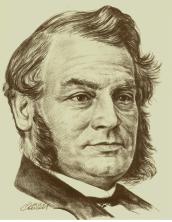
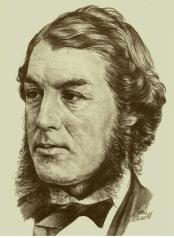
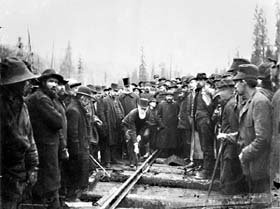
Sandy receives shocking news that her children aren’t safe, which brings back haunting memories of the trauma she experienced as a girl. Then, the unthinkable happens…

A brutal attack puts Sandy on the brink of losing everything she’s loved. Her faith in God and the family she cherishes are pushed to the ultimate limit.
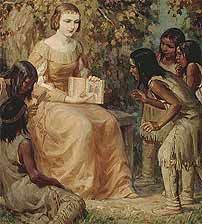
Is healing possible when so many loved ones are hurt? Are miracles really possible through the power of prayer? Can life return to the way it was before?

Blue Sky reveals how a mother’s most basic instinct isn’t for survival… but for family.

If you’re a fan of Karen Kingsbury, then you’ll love Blue Sky. Get your copy today on paperback or  kindle.

-Click to check out our marriage book For Better For Worse: discovering the keys to a lasting relationship on Amazon. You can even read the first two chapters for free to see if the book speaks to you.

  •  

-The sequel book Restoring Health: body, mind and spirit is available online with Amazon.com in both paperback and ebook form.  Dr. JI Packer wrote the foreword, saying “I heartily commend what he has written.” The book focuses on strengthening a new generation of healthy leaders. Drawing on examples from Titus’ healthy leadership in the pirate island of Crete, it shows how we can embrace a holistically healthy life.

In Canada, Amazon.ca has the book available in paperback and ebook. It is also posted on Amazon UK (paperback and ebook), Amazon France (paperback and ebook), and Amazon Germany (paperback and ebook).

Restoring Health is also available online on Barnes and Noble in both paperback and Nook/ebook form.  Nook gives a sample of the book to read online.

Indigo also offers the paperback and the Kobo ebook version.  You can also obtain it through ITunes as an IBook.

To receive a signed copy within North America, just etransfer at ed_hird@telus.net, giving your address. Cheques are also acceptable.

-Click to purchase the Companion Bible Study by Jan Cox (for the Battle of the Soul of Canada) in both paperback and Kindle on Amazon.com and Amazon.ca 

Indigo also offers the paperback and the Kobo ebook version.  You can also obtain it through ITunes as an IBook.

-Click to purchase the Companion Bible Study by Jan Cox (for the Battle of the Soul of Canada) in both paperback and Kindle on Amazon.com and Amazon.ca 

To purchase any of our six books in paperback or ebook on Amazon, just click on this link.